Dr. Rajesh G. Konnur
The earth’s climate is changing rapidly. People are talking about ‘rising temperature’ in natural environments. Every year rising temperatures, rising sea levels and rising fossil fuel emissions are causing global threats to individuals as well as to the natural environment as a whole. It has tremendous impact on bio-psychosocial life conditions.
Climate change is much more than just rise in temperature. It is more than an environmental issue. It has become a socio-psychological & politico- administrative propaganda in the global scenario.
Etiology of Climate Change:
There are two main causes of climate change: natural causes & human created causes. Natural causes have influenced the earth’s climates such as volcanic eruptions, ocean current, earth’s orbital changes and solar variations. The eruptions of volcanoes cause a cooling effect on the earth. When the volcano erupts it throws out large volumes of sulphur dioxide (SO2), water vapor, dust and ash into the atmosphere. The sulphur dioxide gas reaches the upper level of the atmosphere. The tiny particles, dusts & ashes block the incoming sun rays & this leads to cooling of the atmosphere.
One more reason of natural cause for climate change is ocean current. The ocean is the major component of the climate system. It covers 71% of the earth & absorbs about twice as much as of the sun’s radiation as the atmosphere or the land surface. Winds push horizontally against the sea surface & drive ocean current patterns. These also help to restore carbon dioxide. The changes in ocean circulation will affect the climate through the movement of CO2 into or out of the atmosphere. Another reason for climate change is the earth’s orbital changes. The earth makes one full orbit around the sun every year. If there is no tilt we will not experience seasons. Changes in the tilt of the earth can affect the severity of the seasons. For example, if there is more tilt means we will experience warmer summers and colder winters. Similarly, if there is less tilt it means we will experience cooler summers & milder winters.
Over the last 50 years, human activities, particularly the burning of fossil fuels have released sufficient quantities of CO2 and other greenhouse gases to trap additional heat in lower atmosphere & affect the global climate.
In the last 130 years, the world has warmed by approximately 0.850 C. Each of the last 3 decades has been successively warmer than any preceding decade since 1850.
Now, sea levels are rising, glaciers are melting & precipitation patterns are changing. Extreme weather events are becoming more intense and frequent. Climate change is much more than an environmental issue. It poses a serious threat to our health & survival. It impacts all of us, no matter where we live. The health of humanity is directly related to the health of our environment. We depend on our environment for everything. Our environment gives us the air we breathe, the food we eat and the water we drink.
Climate change is not a futuristic scenario that is unlikely to happen in our life time. People are feeling its impact right now in many parts of the globe. A heat wave in the summer of 2003 in Europe caused more than 30,000 deaths and was considered the worst natural disaster in Europe over a period of time. The 2017 Atlantic hurricane season caused unprecedented levels of destruction across the Caribbean. Hurricane Irma was the most powerful ever recorded over the Atlantic. Hurricanes Jose & Maria threatened areas already devastated by Irma.
By 2030, climate change is predicted to cost 2-4 billion U.S. dollars in direct health expenses each year.
Impact of Climate Change on Health:
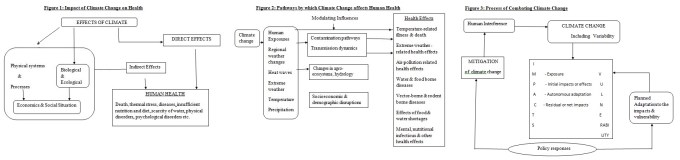
Global climate change directly and indirectly contributes to the spread of diseases & premature mortality. Below is presented a pictorial form of the effects of climate change. Figure 1
Potential Health Impacts of Climate Change:
Change in world climate would influence the functioning of many ecosystems & their member species. Some of the climate change is beneficial. For example, milder winters reduces the seasonal winter time peak in deaths that occurs in temperate countries while in hot regions a further increase in temperatures reduce the viability of the disease transmitting mosquito populations. Overall, however most of the heat impacts of climate change are adverse in nature. According to WHO health report (2012), that climate change was estimated to be responsible for approximately 2.8% of the world wide diarrhea and 8% of malaria in middle income countries.
The first detectable changes in human health may well be alterations in the geographic range (latitude and altitude) and seasonality of certain infectious diseases including Vector Borne infections such as malaria and dengue fever, and food borne infections (Salmonellosis) which peak in the warmer month. Warmer average temperatures combined with increased climatic variability would alter the pattern of exposure to thermal extremes and resultant health impacts.in both summer and winter. By contrast the public health consequences of the disturbance of natural and managed food producing ecosystems, rising sea levels and population displacement for reasons of physical hazard, land loss, economic disruption and civil strife may not become evident for up to several decades.
Adaptive actions reduce health impacts in terms of public health categories of primary, secondary and tertiary prevention. Primary prevention refers to an intervention implemented before there is evidence of disease or injury, avoiding hazardous exposure, removing causative risk factors or protecting individuals so that exposure to the hazard is of no consequence. For example, use of bed nets to prevent malaria. Primary prevention largely corresponds to anticipatory adaptation.
Secondary prevention involves intervention implemented after disease has begun, but before it is symptomatic (example: early detection or screening) and subsequent treatment that averts full progression to disease. Examples include enhancing, monitoring and surveillance, improving disaster response and recovery and strengthening the public health system’s ability to respond quickly to disease outbreaks. Secondary prevention is analogous to reactive adaptation. Finally, tertiary prevention attempts to minimize the adverse effect of an already prevalent or injury (for example better treatment of heat stroke, improved diagnosis of vector borne diseases). As the adverse health outcome is not prevented, tertiary prevention is inherently reactive.
Coping with climate:
In popular literature global climate change frequently is called “global warming” which focuses attentions on average global temperature change. However, a change in climate actually occurs as changes in particular weather condition, including extremes in specific places. Adaptation to climate change necessarily includes adaptation to variability. Figure 2:
Combating Climate Change : Figure 3:
Process of Combating Climate Change
The various measures of combating climate change are as follows:
- Save electricity while not in use. Loss of electricity leads to climate change.
- Do not waste food: Food loss and waste generates more than 4 times as much as annual greenhouse gas emission as aviation.
- Eat less meat: A staggering is 51% or more of the global greenhouse gas emissions are caused by animal agriculture. Owing to a report published by the World Watch Institute according to UN, a global shift towards vegan food habits is a necessity to combat the effects of climate change.
- Reduce the use of fossil fuel: Fossil fuel combustion releases carbon dioxide, nitrogen oxide, methane and other harmful emissions in the air.
- Use of solar energy: Solar power systems derive clean, pure energy from the sun. These combat emissions and reduce our collective dependence on fossil fuel.
- Reduce use of plastic: Plastic is a big environmental threat. It is non-bio-degradable and causes emission while burning.
- Ride a bicycle: Bicycle does not cause harm to the air. An average car produces about 1.3 billion cubic yards of polluted air over the course of its life span.
Role of Nurses in Climate Change:
Adaptation to climate has always included “physiological acclimatization, behavioral strategies (such as clothing, scheduling daily work & seasonal migration), technical measures (such as building design and air conditioning) & institutional mechanisms (e.g. disaster preparedness schemes). What is changing now is the pace of climate change which may overcome the capacity of populations to adapt.
Nurses have a role to play in advocating for action to reduce societal inequities, strengthen public health infrastructure, promoting behavioral strategies that foster adaptation to change, promoting positive change adaptations to major life changes, such as the birth of the child or the diagnosis of a chronic illness. Nurses working in communities have to address various stressors. This same expertise can be used to support adaptation to climate change in a way that promotes and maintains the health of the individuals, families and communities. The other roles are:
- Maintaining effective mitigation programs such as mosquito control.
- Health information dissemination and education.
- Collaborating with emergency and disaster management departments.
- Advocating environmental policy change.
- Developing proactive waste management plans.
- Participating in interdisciplinary teams to develop strategies to address health impact of climate change.
- Conducting research on climate change and health.
References:
- The Impacts of Climate Change on Human Health in U.S. (2016).
- The Role of Nurses in Addressing Climate Change. CNA. (2010).
- Gender, Climate change and Health. WHO. (2017).
- Climate Change and Human Health. A. J. Mc Michael .et. al (2008).
- http:/envirn.org/climate-change/.
 Concept Research Foundation
It is time for timely action
On Sat, 21 Apr 2018 8:53 pm Concept Research Foundation, wrote:
> [image: Boxbe] This message is eligible > for Automatic Cleanup! (comment-reply@wordpress.com) Add cleanup rule > > | More info > > Concept Research Foundation posted: “Dr. Rajesh G. Konnur The earth’s > climate is changing rapidly. People are talking about ‘rising temperature’ > in natural environments. Every year rising temperatures, rising sea levels > and rising fossil fuel emissions are causing global threats to individua” >
LikeLiked by 1 person
Thanks Madam.
On Sat, Apr 21, 2018 at 3:51 AM, Concept Research Foundation wrote:
> Concept Research Foundation posted: “Dr. Rajesh G. Konnur The earth’s > climate is changing rapidly. People are talking about ‘rising temperature’ > in natural environments. Every year rising temperatures, rising sea levels > and rising fossil fuel emissions are causing global threats to individua” >
LikeLiked by 1 person