Brian Tracy and his contributions on time management

Topic Courtesy Mr Anamitra Roy

Compiled by Mr Prapanna Lahiri

Brian Tracy is one of America’s leading specialists on enhancement of personal effectiveness, increasing self awareness, development of human potential and art of salesmanship. He now heads his company Brian Tracy International which specialises in training and development of individual capabilities. He has offered consultancy to more than 1000 companies and has spoken in no less than 5,000 talk shows addressing 5 million people worldwide about ways and means for faster achievement of individual and organisational goals. He has authored 60 books including the best seller ‘Psychology of Achievement’ and has produced more than 500 audio and video learning programmes on enhancement of professional effectiveness. Before he founded his company he was the Chief Operating Officer of a $265 million dollar development company. He has contributed his expertise in a wide arena of disciplines such as Professional Training and Coaching, Business Coaching, Business Training, Entrepreneurial Success, Management Skills, Speaking Techniques, Power Networking, Personal Development, Sales Training, Leadership, Online Learning and Time Management.

Time management is one area which is of immense value in today’s fast paced world. Success or failure of an executive greatly depends on how well time is managed. Time is an irreplaceable resource, a precious asset which is inexorable and cannot be saved; it cannot be retrieved once lost. In prospective terms, one can always think one would make more money on the next contract, one would do a better job on the next project, one could have better luck with the next relationship but the one invaluable resource lost would be time that went by. Better someone utilises time today, greater is the reward.

Brian Tracy’s prescription for better time management is based on the following organisational skills:

  1. The work programme for the entire next day should be planned the night or the evening before. Before reaching home from work on a day, one should have chalked out and written down the task list for the following day. Once the plans are done in black and white, one will not have a sleepless night before.
  2. It is important to decide how to schedule one’s time properly. It is worthwhile to know what to do next every time one item is completed on one’s to-do list. Having planned for a day, a week or a month will lend someone greater feeling of control over the time to be consumed for planned actions.
  3. It is essential to identify the most valuable things one does at work. The motto is to organise one’s time in such a way that will facilitate doing more of these.
  4. An early start to a day will give one enough time to think and quietly reflect on the tasks ahead for the day. This can help one save many hours while actually executing the said tasks.
  5. A better organised filing system at home or work is important to avoid wastage of time in looking for misplaced materials, during working hours. A simple alphabetical order of filing, backed by maintenance of a master record of title and location of a file, will be an easily workable retrieval system.
  6. It is important for an executive to structure the working day by identifying his/ her “Internal Prime time” and the “External Prime Time.” Internal prime time is the time of the day when the body clock of a person allows him/ her to remain most alert, creative, rested and productive. One should be aware of one’s internal prime time to schedule the most important jobs during this period, for maximum productivity. On the other side the external prime time is the time when the customers and clients are readily available.
  7. Hard work without interruption for long periods is an enormously powerful way to increase productivity. Real time studies have revealed that one hour of uninterrupted work during travelling is equivalent of three hours of work in a normal work environment. The emphasis is on the word “uninterrupted.”

The type of time management that Brain Tracy essentially advocates is “a proven time management system that will help you stop wasting time and start getting more important tasks done faster!” Tracy’s clue is “stop procrastinating and get more done in less time!”

Reference:

http://www.briantracy.com/blog/time-management/time-management-getting-things-done-hard-work/
Ultrasound

Compiled By : Aamarpali Puri

Sound waves with frequencies higher than upper audible limit of human ear and which cannot be heard by humans are called ultrasound waves. Human hearing limit is between 20Hz – 20,000Hz. Humans cannot hear sounds having frequency less than 20 Hz and greater than 20,000Hz. Infrasound has frequency less than 20 Hz. Ultrasound has frequencies more than 20,000Hz. Ultrasound refers to anything above the frequencies of audible sound, and nominally includes anything over 20,000 Hz.

Ultrasound has application in various fields.

Ultrasonic humidifier: one type of nebulizer is a popular type of humidifier. The ultrasonic pressure waves nebulize not only the water but also materials in the water including calcium and other minerals.

Ultrasonic door opener: A common ultrasound application is an automatic door opener, where an ultrasonic sensor detects a person’s approach and opens the door.

Ultrasound generator/speaker systems are sold as electronic pest control devices, which frighten away rodents and insects.

Whales and dolphins, can hear ultrasound waves and use such sounds in their navigational system to orient and capture prey.

Ultrasound is also used to visualize fetuses during routine and emergency prenatal care. Such diagnostic applications used during pregnancy are referred to as obstetric sonography.

Medical sonography is an ultrasound-based diagnostic medical imaging technique used to visualize muscles, tendons, and many internal organs, to capture their size, structure and any pathological lesions with real time images.

In this context, let us talk about whistling. Dog can hear ultra sound; dog whistle emits a high frequency sound to call to a dog. Many such whistles emit sound in the upper audible range of humans.

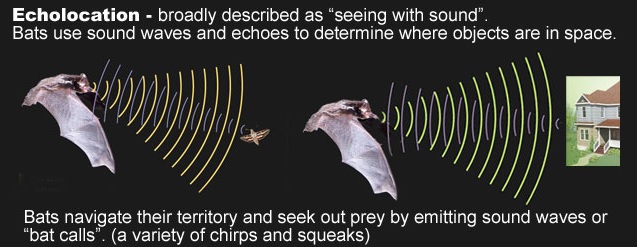
Bats use ultrasounds to navigate in the darkness. Bats use a variety of ultrasonic ranging techniques to detect their prey. They produce high pitched ultrasound squeaks. These high pitched squeaks are reflected by objects such as preys and returned to the bat’s ear. This allows bat to know the distance of his prey. They can detect frequencies beyond 100 KHz, possibly up to 200 kHz.

Ultrasound can also provide additional information such as the depth of flaws in a welded joint. Ultrasonic inspection has progressed from manual methods to computerized systems that automate much of the process. An ultrasonic test of a joint can identify the existence of flaws, measure their size, and identify their location.

Defects in metal blocks can be detected using ultrasound. Defects do not allow ultrasound to pass through them and they are reflected back as a result, it doesn’t get detected by the detector.

Diagnostic ultrasound is used externally in horses for evaluation of soft tissue and tendon injuries, and internally in particular for reproductive system.

Ultrasound is used to evaluate fat thickness, rib eye area, and intramuscular fat in living animals. It is also used to evaluate the health and characteristics of unborn calves

Ultrasonic cleaners frequency 20 to 40,000 Hz, are used to clean jewelry, lenses, optical instruments, watches and surgical instruments etc. An ultrasonic cleaner works mostly by energy released from the collapse of millions of microscopic cavities near the dirty surface. Objects to be cleaned are put in a cleaning solution and ultrasound waves are passed through that solution. The high frequency of these ultrasound waves detaches the dirt from the objects.

It is also used in killing bacteria in sewage. Ultrasonic cleaning is the rapid and complete removal of contaminants from objects by immersing them in a tank of liquid flooded with high frequency sounds waves. These non-audible sound waves create a scrubbing brush action within the fluid.

SONAR (Sound Navigation And Ranging) is an acoustic device used to measure the depth, direction and speed of under-water objects (submarines etc) with the help of Ultrasounds. It is used in measuring the depth of seas too. A beam produces by this device is passed through sea. This beams gets reflected and the echo is recorded by the detector, which converts it to electrical signals. This method is termed as ‘echo – ranging’.

The Product Life Cycle and The Law of Diminishing Returns: An Union of Marketing Management and Economics

By: Anamitra Roy

B.Com. Hons. (University of Calcutta, India), Certified Financial Accountant (CMC, India),DFA (CMC, India), PGDBF (HSIS India, India), Certified Business Case Analyst (TASMAC, India), Certified Financial Accountant (GLOBSYN Skills, India), GPBL (TASMAC & University of Wales, U.K.).

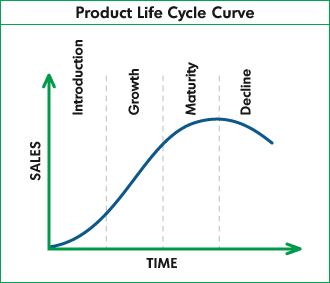
One of the most important concepts associated with modern day marketing management is that of the product life cycle. In this concept, the life span of a product is classified broadly into three classifications, which are as follows:

  1. The Phase of Introduction/ Development: This is the first phase of the product life cycle. In this stage the product gets developed. It gets introduced in the market. In this phase the entrepreneur has to work very hard to make the customers familiar with the product. Some marketing management scholars also prefer to call it the phase of formation.
  2. The Phase of Maturity: This is the second phase of the product life cycle. In this stage the product reaches a state of maturity and customers are very familiar with it. The product has the highest aggregate demand in the market at this stage. This is the stage when the entrepreneur earns the highest amount of profit and holds the lion’s share of the market sales.
  3. The Phase of Declining: The third and final phase of the product life cycle can be delayed but it cannot be eradicated.This is the third and final phase of the product life cycle. In this stage the demand for the product starts to come down in the market, thereby, bringing the profit margin also to an all time low. Another major characteristic feature of the declining phase from the point of view of human resource management is that motivation level of the employer and the employees also continue to go down.

Every product in the world has to undergo these three phases of the product life cycle irrespective of the nature and utility of it.

Quite similar to the product life cycle of marketing management there is a law in economics. This is called the “Law of Diminishing Returns.” This law deals with the diminishing returns/ utility value from the continuous use of a resource. For example, when a person is having a bottle of soft drinks say the utility derived out of that is “x”. Now on having the second bottle of soft drinks the utility value comes down to lesser than “x”. On having one more bottle of soft drink the utility value comes down further and it continues this way until at one point of time the utility value reaches the zero mark.

There are some points of similarity between the product life cycle of marketing management and the “Law of Diminishing Returns” of economics. A discussion on these is as follows:

  1. Based on the fundamental principle of diminishing marginal utility: In case of both the concept of product life cycle and the “Law of Diminishing Returns”, the marginal utility comes down due to factors like -Marginal utility is the utility of having an additional unit of the product. In the concept of product life cycle the demand for the product slowly and gradually comes down and then fades away. In the “Law of Diminishing Returns” also the same principle of diminishing marginal utility is used as a base.
  • Fatigue generated out of regular usage.
  • Monotony.
  • Changes in consumer behavior leading to alterations in tastes, preferences, buying and usage patterns of consumers.
  • Introduction of superior quality products in the market.
  • Improvement of competitors in terms of technology, management etc.
  • Rise in awareness leading to optimum usage of resources, thereby bringing the cost of substitute products down in the markets.

2. Applicable in case of individual and aggregate use: The concept of product life cycle and the “Law of Diminishing Returns” can be used in case of individual as well as aggregate usage of the market. The individual usage added together produces the aggregate usage.

3. Applicable in case of all types of products: In case of medicines and cancer drugs, the utility (satisfaction) value remains the same even after repeated usage. Hence, the demand for these commodities does not fall as per the “Theory of Marginal Utility.”

Giffen goods have been named after the famous Scottish economist Sir Robert Giffen. The world famous economist Alfred Marshall attributed this idea to Sir Robert Giffen in his book “Principles of Economics”. In economics and consumer theory, a Giffen good is a commodity whose demand does not fall with the rise in prices and vice versa. Examples of such goods are luxury goods like perfumes, art pieces, paintings etc.

Both the ideas in the discussion are applicable in case of all types of products. However there are some exceptions to it. Examples of these are medicines, cancer drugs, Giffen goods etc.

In spite of these similarities, there is a strong dissimilarity between the idea of product life cycle and the “Law of Diminishing Returns”. This difference is in the approach. The idea of product life cycle approaches to study the law of diminishing marginal utility from the stand point of a product. On the other hand, the “Law of Diminishing Returns” approaches to study marginal utility from the standpoint of utility or satisfaction.

In reality it is seen that the “Law of Diminishing Returns” is used to analyze the product life cycle. The stats of changing/ diminishing returns help us to understand in which phase of product life cycle the product is existing right now.

In this context, let me talk about one of my experiences.

In 2011 -12, I was working as the Centre Manager of the CMC Academy, Salt Lake City Branch which was situated in Salt Lake City, Kolkata, India. As the head of the organization I was very worried since September, 2011, as my business acquisition figures went drastically down and could not be pulled up despite measures taken by the marketing team. It was on January, 2012 we decided to interview the existing students of the institute on the basis of a questionnaire. This was being done with the objective of judging their satisfaction level. After the interview and in consultation of my bosses we realized that the academic courses being taught in the institute had reached a point of saturation. The stats revealed that following the “Law of Diminishing Returns”, the satisfaction generated from the academic courses taught in the institute were coming down like a house of cards, there by taking the whole institute towards the third and declining phase of the product life cycle.

We had limited time in our hands as we had to reach targets. We got tied up with the National Institute of Entrepreneurship and Small Business Development”. There was a flow of new products in the form of a new advance course on web designing. Our marketing team conducted two seminars at a nearby government college and we had 50 more students in just a month. By March, 2012 things were back in shape again. Organizational happiness and stability were restored.

In my professional career, this was a classical example of the “Law of Diminishing Returns” used to determine the phase of the product life cycle in which our products were placed. This is how, I realized about the union between marketing management and economics through the application of the concept of the product life cycle and the “Law of Diminishing Returns”.

How important is it for a marketing personnel to be happy?

By: Anamitra Roy

B.Com. Hons. (University of Calcutta, India), Certified Financial Accountant (CMC, India), DFA (CMC, India), PGDBF (HSIS India, India), Certified Financial Accountant (GLOBSYN Skills, India), GPBL (TASMAC, India & University of Wales, United Kingdom).

“Happiness is the secret to all beauty. There is no beauty without happiness.”

Christian Dior

 It was back in 2012 that I was reading an article on happiness. I still remember the writer raised a question in his writing. He asked the readers that how are it that some people are perennially happier and some are unhappy. The writer through his research reached the conclusion that happiness besides being dependent on social, political, technical, economical, geographical factors is also to a huge extent dependent on the genetic factors. I was very moved with this article although after so many years I do not remember the name of the writer or the article. I was very moved because right from my childhood I was very close to my Mom, who herself is a very happy person and has grown me to a happy person. So I could relate to the conclusion pointed out in that article that happiness is to a huge extent genetic. After that I went through a management program called “Global Program in Business Leadership (GPBL)” conducted by the TASMAC B – School and the University of Wales, United Kingdom. I had taken marketing management as my area of specialization in the yearlong GPBL program. After completion of this management program, I started to think about the importance of happiness in the marketing profession. I discussed about this with a lot of people. I closely observed the lives of many mid-level and top level marketing executives. I myself started to work as a marketing person. As a result of all these I reached a few conclusions in my mind which I am sharing with you all.

Let me clarify in the beginning that these conclusions are a result of observation and not research. So they can very easily be challenged. But still, I am sharing these conclusions with you all, because if you find it applicable in your life that would save time for the applicant. I have taken almost four years to reach to these conclusions. If, after reading this article, one can learn those in half an hour, then that would save time for that person and also for the entire human race as a whole. Thus, I will consider this as my share of contributions towards the growth and continuance of the human civilization.

On that note, my observations are as follows:

  1. Relating to the needs of the customer:I will give you a simple example. I was once having a chat with a renowned dermatologist. He was telling me about one of his experiences with a patient. This patient was a young man. He had developed a white patch in his arm. Within a span of almost ten years, it occupied a major portion of his arm. He never had any problem with this white patch because this skin disease was painless. But he started to have a problem with it the moment his marriage was fixed. He was embarrassed about the white portion of his arm. After all, all of us love to pose a perfect picture of ourselves in front of our newly married ones. That’s basic human psychology and I do not want to expand on that. The young man met the dermatologist in his chamber and requested him to remove the white patch in ten/ fifteen days. The dermatologist told him that a problem that was there for ten years cannot be eradicated in just a few days. But he promised to manage it to the highest extent possible within ten days. Trust me; this was one of the greatest stories of how someone could relate to the needs of another. Marketing is all about relating to the needs of the customers. For this you need to think. You can think well when you are happy. Thus you need to be happy in order to relate yourself to the needs of the customers. I was always and almost always told by my teachers that marketing is ultimately trying to relate you with the needs of the customers. You will have to fit in the shoes of your customers/ clients. Then only you will be able to relate to them.
  2. Endorsing the Brand: There are so many celebrities around the world who endorse brands. In India some of the most popular brand ambassadors are actors like Amitabh Bachchan, Shah Rukh Khan, Aishwarya Rai, sports personalities like Sachin Tendulkar, Mahendra Singh Dhoni, Sania Mirza etc. All these personalities while endorsing whichever brands they endorse do it with a happy face. A happy face is easily approachable than a gloomy face and so people are fond of happy faces. This is not only true in case of celebrities but also in case of marketing persons. When a marketing person approaches a client/ customer he is the sole representative of the organization. People do not care about who is the CEO of the organization. For them the marketing person that they meet in shops, malls, outlets and markets, represents the whole organization. That is why, it is extremely important for the marketing person to approach the customers/ clients with a happy face. This is because the happy face of the marketer says that the organization that he is representing is a happy one.
  3. Product Life Cycle: Let me for the time being, concentrate on the third and final phase i.e. the stage of declining. This is a stage that is unavoidable. It can be delayed but it cannot be avoided. Marketing scholars around the world are researching on how to delay the arrival of this declining phase. If I am asked personally, then I would say that this is the phase when happiness is most wanted to keep the work force motivated but at the same time this is also true that this is the phase when happiness is most difficult to achieve. This is because a declining graph indicates cash crunch, lack of confidence of the employees, internal feud within the organization and lack of interest in the job. There is only one solution to this. The answer is happiness. Happiness is the only way by which you can delay the arrival of the third and declining phase. A happy mind can take up more pressure and work load. To delay the arrival of the third and final phase you need to work more and achieve the targets. That’s possible only if you posses a happy mind. There are three phases of product life cycle. The first phase is the phase of introduction, the second phase is the phase of maturity and the third phase is the phase of declining.
  4. Absorption of Pressure: I remember as a growing kid I used to watch a lot of sports in the nineteen nineties. At that time, Ajay Jadeja was a very popular sporting star who represented India at the international level. He always had a smiling face. Even when he was playing and his team was losing he would smile. He was a happy person and he displayed his happiness … a great way to tackle pressure. In a lot of interviews, Jadeja spoke about this habit that he had developed since his childhood. He always believed that this was his way of tackling pressure. In the marketing profession, you will be under severe pressure. This pressure comes from your employer, your clients, your customers, your team members and also sometimes from yourself. You will have to absorb this pressure. There are ways of doing it. Absorption of pressure is a science. It is not an art. It is not dependent on individuals. You can absorb more pressure when you are happy. You can work more when you are happy. In all the leading organizations you will see the HR department working towards the happiness of employees. In fact, this is a new and very interesting vertical that has been added to the field of HRM. I remember when my Dad worked for Union Carbide; he was the member of the Volt ‘n Half Recreation Club. This was an in-house club for the working executives of that company who used to arrange periodical picnics, get together programs, musical performances by eminent musicians and other cultural activities. All these used to be done to keep the executives happy.
  5. Decision Making: Decision making is a principle of management that is common to whichever field of life you are. But it is particularly important in the field of marketing. In this field when you are taking decisions, your decisions will be influencing the fate of the organization. And, that’s true even if you are just a junior executive. You are taking decisions about the product, about how to pitch the product, about the approach to the customer/ client. Even if you are not the CEO, your decisions have the strength to influence the image and future of the organization. Now, how do you think every minute you are going to take decisions as crucial as these if you are not happy? Happiness is that important in the field of marketing. It will enable you to work freely and take decisions freely.

In conclusion, let me share with you all that there have been days in my career when I have received the most horrible of the thrashings from my boss. These had happened at times without any fault of mine. How do I recover in just one day? I had to go to the office the next day and face the same boss. Happiness is extremely important in whichever sphere of life you are but it is particularly important in the field of marketing. It will help you to go on and on despite the severe pressure. In this field of marketing on some days you would be required to travel more than 200 kilometers in a day, sometimes when the temperature is around 45 degrees Celsius. You know, I have personally experienced this that when you are in such a situation although marketing may be your passion, your life; still you may curse yourself for taking up this profession. The question is in such a phase of your life when you are cursing yourself for taking up this profession which is the best according to you, how do you inspire yourself? The answer is simple. “Happiness.” Be happy and you are done.

This write up that I have written is to a huge extent autobiographical. I have looked at life and learnt these lessons that I have shared with you in this writing. Please do feel free to share your opinions with me at my mail ID which is roy_2009@rediffmail.com

I would love to hear from all of you … my dear readers.

“Thousands of candles can be lighted from a single candle, and the life of the candle will not be shortened. Happiness never decreases by being shared.”

Buddha

Importance of Planning as a Management Function

By Prapanna Lahiri

Planning is the first managerial function. In exercising this function the manager will create a detailed action plan aimed at achieving some organisational goals. Planning is an ongoing function and can be highly specialised based on organisational goals, division goals, departmental goals, and team goals.

Definitions:

Based on the above statements Planning can be defined as a – systematic activity of thinking in advance to determine when, how and who is going to perform a specific job. Planning entails setting objectives and deciding in advance the appropriate course of action to achieve these objectives.  Accordingly, one can also define Planning as setting up of objectives and targets and backing it up with an action plan to achieve them. Simply put, Planning is a detailed programme regarding future courses of action.

Importance of Planning:

It is a systematic and specialised organisational activity in view of its following distinctive characteristics:

  1. Planning follows objectives: Planning begins with determination of objectives which provide the nucleus to the planning process. After the objectives are set, planning decides the methods, procedures and steps to be followed to achieve these objectives. Objectives should be practical, acceptable, workable and achievable.
  2. Planning is pervasive: Planning is not restricted to the top level of management only but is also done by managers at every level. Depending on goals set at every level – be it a department, a division or a team assigned a specific job, a planning blueprint has to be drawn up.
  3. Planning is futuristic/ forward looking: Since Planning is essentially looking ahead, it is a futuristic function. Planning cannot be done for the past. Based on past experiences managers attempt to make predictions and assumptions called ‘Planning Premises’ about the likely shape of events in future. Planning premises may be internal or external. Internal premises that may include capital investment policy, management labour relations, philosophy of management etc. are controllable whereas external premises that include socio- economic and political changes are non- controllable. The premises are established for determining where one tends to deviate from the actual plans and causes of such deviations.
  4. Planning is ongoing/ continuous: Planning is a never ending process. When forecasts are available and premises established, a number of alternative courses of action are taken for consideration. Alternatives are scientifically and objectively evaluated by employing quantitative techniques, weighing their pros and cons in the light of resources available and requirements of the organisation. The best alternative is chosen, basis its stability to attain the desired objective. There is scope for course correction midway depending on the prevailing environment.
  5. Planning is a mental exercise: Planning is an intellectual process requiring higher level of thinking and mental exercise. F.W. Taylor, the proponent of the theory of Scientific Management wrote about applying scientific (quantitative) techniques to planning. He separated planning from operational activities. In planning, assumptions and predictions regarding future are made by scanning the environment properly. Planning requires higher level of intelligence to select the most suitable alternative after evaluating various alternatives.
  6. Planning provides Direction: Planning being a predetermined course of action provides the directions to the efforts of employees. After the plans are formulated the subordinates who have to implement these plans are taken into confidence telling them in advance about the direction they have to tread. This ensures ‘Unity of Direction.’ Without planning, employees would be working in different directions making it impossible for the organisation to achieve its desired goals.
  7. Derivative/ secondary plans formulated: Secondary and Sub plans are derived from the basic plan detailing policies, procedures, rules, programmes, budgets, schedules, etc. for each department. All employees, supervisors and managers will integrate their activities based on these plans.
  8. Planning Reduces uncertainties: Planning premises being assumptions regarding future uncertainties based on past experiences uncertainties are sought to be minimised.
  9. Planning facilitates Management by Exception: Controlling means comparison between planned standards and actual output. Variances are calculated and analysed to their causes to find what went wrong and where.
The purpose of planning becomes meaningless unless its efficacy is evaluated. The appraisal of plans enables the planners to correct deviations or modify future plans to make them more realistic.

Reference:

http://www.ncert.nic.in/ncerts/l/lebs104.pdf

http://www.managementstudyguide.com/planning_function.ht

http://study.com/academy/lesson/frederick-taylor-theories-principles-contributions-to-management.html

Hypothermia

By: Aamarpali Puri

Hypothermia means losing heat faster than one’s body can produce it, causing a drop in (inner) body temperature. If body is immersed under cold water, heat escapes from the body thus speeding up hypothermia. Human being need cloths to keep them warm unlike other warm-blooded animals that have a layer of hair to keep them warm. Without that extra layer of clothing, more heat escapes from the body than the body can produce. Extended exposure to cold temperatures or a cool, damp environment causes Hypothermia. It leads to decrease in body temperature, impaired consciousness, and slurred speech, very slow rate of breathing, fatigue, lethargy, confusion, or disorientation. The affected person should be kept warm and dry indoors. Elderly, intoxicated or very young people are vulnerable.

  • Advanced age. People aged 65 and older are especially vulnerable because they usually have other illnesses or take medications that can interfere with the body’s ability to regulate temperature.
  • Very young age. Children usually lose heat faster than adults do. Children have a larger head-to-body ratio than adults do, making them more prone to heat loss through the head. Infants may have a special problem with the cold because they have less efficient mechanisms for generating heat.
  • Alcohol and drug use. Alcohol may make your body feel warm inside, but it lowers your body’s ability to retain heat. It keeps our blood vessels dilated, restrict your shivering response, impair your judgment and alter awareness of weather conditions.
  • Certain medical conditions. Some health disorders affect the body’s ability to respond to cold or to produce heat. Examples include untreated under active thyroid (hypothyroidism), stroke, severe arthritis, Parkinson’s disease, trauma, spinal cord injuries, burns, blood vessel or nerve disorders that affect sensation in your extremities (for example, peripheral neuropathy in people with diabetes), dehydration and any condition that limits activity or restrains the normal flow of blood.

Some valuable tips to avoid hypothermia:

  • Eat properly with plenty of carbohydrates and fats for energy and warmth.
  • Drink plenty of water.
  • Get enough sleep. Being well rested will make you feel energized and positive.
  • Remove any wet clothes immediately. They cause accelerated heat loss and impair movement.
  • Insulate well, particularly the head and neck as these are the areas which lose the most heat the quickest.

Prevention
Avoid alcohol consumption and the use of illegal substances should be stopped because these increase the risk of hypothermia. Since alcohol lowers the body’s resistance to cold water, it greatly increases the effect of torso reflex (the unexpected blast of cold water causing an automatic gasp for air) by increasing the metabolic rate and demand for oxygen in frigid water. As the alcohol level in a person’s body increases, coordination abilities decrease.

Before stepping out into cold air, remember the advice that follows with the simple acronym COLD:

  • C for cover. Wear a hat or other protective covering to prevent body heat from escaping from your head, face and neck. Cover your hands with mittens instead of gloves. Mittens are more effective than gloves because mittens keep your fingers in closer contact with one another.
  • O for overexertion. Avoid activities that would cause you to sweat a lot. The combination of wet clothing and cold weather can give you chills.
  • L for layers. Wear loose fitting, layered, lightweight clothing. Outer clothing made of tightly woven, water-repellent material is best for wind protection. Wool, silk or polypropylene inner layers hold more body heat than cotton does.
  • D for dry. Stay as dry as possible. In the winter, pay special attention to places where snow can enter, such as in loose mittens or snow boots.

References:

  1. http://www.emprc.org/jan98/chill.html.
  2. http://www.climbing-high.com/hypothermia.html.
  3. http://www.seagrant.umn.edu/coastal_communities/hypothermia.

Smart Cities

By Prapanna Lahiri

The worldwide trend of people flocking in large numbers from the countryside to settle down in old historical cities and new evolving cities forced urban administrators and planners to start looking for more innovative solutions to the challenges to urban living. The local and national governments face challenges of finding smarter infrastructure solutions in the areas of housing, jobs, food, transport, energy, communication networks and technological innovations for cleaner environment. From these challenges has emerged the concept of ‘smart city’ which in many ways is the ideal habitat that provides smarter solutions to all these urban imperatives.

There is no universally accepted definition of Smart City which means different things to different people. It would carry a different meaning in India than, say, in Europe. The idea of a smart city primarily begins with using digital technology that makes a city more efficient and improves wellbeing of its inhabitants. The concept of ‘Smart Cities’ became popular within the European Union. Studies show that the cities consume 75% of worldwide energy production and generate 80% of CO2 emissions. Accordingly, the European Community’s initiatives for Smart Cities focussed, among other factors, on issues of sustainability such as buildings, energy networks and transport.  Definition: The Business Dictionary defines a smart city as “a developed urban area that creates sustainable economic development and high quality of life by excelling in multiple key areas; economy, mobility, environment, people, living, and government. Excelling in these key areas can be done so through strong human capital, social capital, and/ or ICT infrastructure.” [ICT stands for Information and Communication Technology].

A simple definition of smart city could be — a city equipped with basic infrastructure to give a decent quality of life, a clean and sustainable environment through application of some smart solutions.

The relative emphasis on various characteristics that define a smart city should be in conformity with the level of development, willingness to change and reform, available resources and aspirations of the city residents. Two other terms, namely, ‘intelligent city’ and ‘digital city’ have also been used while describing ‘smart cities’.

In India: The National Democratic Alliance (NDA) government, since taking over, has focussed particular attention on the urbanisation front. From the very beginning of his election campaign in 2014, Prime Minister Narendra Modi had spoken about building 100 smart cities in India. This has been part of the great Modi vision to make this – India’s century alongside other ambitious schemes like bullet trains and linked rivers. The Modi government’s concept of a smart city goes a bit broader, basically meaning any city that also works well, particularly for businesses.

Investment: The Union Government has planned to select 100 cities in three phases — 20 in 2015-16 and 40 each in subsequent years to be developed as Smart Cities. The Smart Cities Mission was allocated an aggregate outlay of Rs 48,000 crore, with Rs 100 crore earmarked for each city per year for successive five years. The aggregate investment in urban renewal though looks huge; the investment per city seems relatively small making it clear that the government expects most of the financial support for smart cities to come from private investment. The government also announced relaxation of norms for foreign direct investment from overseas companies to invest in smart cities. The government has mooted the idea of Special Purpose Vehicles to be set up for smart cities by each state to ensure their financing. Collaborations have also been sought from France, Japan, Singapore and other countries for the projects. The intent also is to link this mission to other key projects of the government such as Digital India and Swachh Bharat (Clean India).

Smart City Mission of the government envisions taking courageous and path breaking initiatives. It intends setting examples which could be replicated both within and outside the Smart City. The initiatives can catalyse creation of similar Smart Cities in various regions of the country. The mission encompasses the following core infrastructure elements for a smart city:

  1. Assured electricity supply
  2. Adequate water supply
  3. Affordable housing (especially for the poor)
  4. Sanitation, including solid waste management
  5. Storm water drainage to reduce flooding
  6. Efficient public transport and urban mobility
  7. Pedestrian only zones and parking spaces
  8. Health and education
  9. Safety and security of citizens, particularly women, children and the elderly,
  10. Sustainable environment
  11. Durable IT connectivity and digitalisation,
  12. Good governance, especially e-Governance with citizens’ participation.

Smart Cities need Smart Solutions designed to improve quality of life. Solutions to be called smart should be right sized to the challenges they are required to address; bigger is not necessarily better. Some of the smart solutions to the core infrastructure elements picked from experience of urban planners the world over are: −

  1. Smart IT and Communications
  • Digital Empowerment
  • Broadband and Wi-Fi connectivity
  • Smart Phones and Mobile Apps

     2. E-Governance and Citizen Services

  • Citizen Engagement in planning/ feedback
  • Public Information/ Grievance Redressed.
  • Electronic Service Delivery (E-filing forms, Fault Booking, Issuing Licence, Permit & Certificates and E-Payment & Receipt
  • Video Crime Monitoring

      3.    Waste Management

  • Waste segregation
  • Waste to Energy/ Fuel/ Compost
  • Treating Waste Water/ Recycling
  • Reduction/ Recycling of Construction & Demolition Waste

     4. Water Management

  • Smart Water Meters/ Consumption Monitoring
  • Leakage Identification, Preventive Maintenance
  • Water Quality Monitoring
  • Rain Water Harvesting

    5. Energy Management

  • Smart Energy Meters
  • Renewable Energy sources
  • LED Lighting
  • Energy Efficient & Green Buildings

    6. Urban Mobility

  • Smart Parking concepts
  • Intelligent Traffic Management
  • Integrated Multi-Modal Transport

    7. Others/ Miscellaneous

  • Smart Buildings, Smart Living Solutions
  • Smart Disaster Management Strategies
  • Tele-Medicine & Tele Education
  • Incubation/ Trade Facilitation Centres
  • Skill Development/ Sustainable livelihood

A “Smart City” has been visualised as an urban model where sustainability, economic development and a high quality of life constitute the key factors. The vision is for an urban space which is ecologically friendly, technologically integrated and precisely planned, making maximum possible usage of information technology to improve efficiency.