SOCIAL RESPONSIBILITY NO LONGER OPTIONAL FOR CORPORATES: A STUDY ON CORPORATE SOCIAL RESPONSIBILITY

By: Dipannita Ganguly

 “The business of business is business”

Friedman

The modern business era has undergone a huge change, aiming at market oriented yet having a responsible behavior towards customer instead of sustainable business success and shareholders’ value solely through maximizing short-term profits. Nowadays business wants to contribute towards sustainable development by operating and managing their resources in such a way that it enhances the economic growth and competitiveness, keeping pace with environmental protection and promoting and enhancing the social responsibility, thus the consumer interests.

Corporate Social Responsibility

Definition & Concept

Corporate Social Responsibility is the continuing commitment by business to behave ethically and contribute to economic development while improving the quality of life of the workforce and their families as well as of the local community and society at large.1

The concept of Corporate Social Responsibility is an emerging and evolving concept, not having a universally accepted definition. Sometimes this concept is also referred to as ‘Corporate Citizenship’.

CSR may be meant to understood the way by which the business enterprises tries to integrate social, economic and environmental concerns into their working, with emphasis into their values, culture, decision making, strategy and operations in a clear and transparent manner, by which they can establish better practices and thereby increase the wealth of society and march towards its improvement.

Thus, Corporate Social Responsibility can be explained as under-

Corporate –means an organized business.

Social– the concept of dealing with society or people in general

Responsibility– a sense of accountability for the working of the business enterprises towards their customers.

In general, the philosophy is basically to return to the society what the business enterprises has taken from it in the course of its quest for creation of wealth.

 A Contract with Society

“The broadest way of defining social responsibility is to say that the continued existence of companies is based on an implied agreement between business and society. In effect, companies are licenses by society to provide the goods and services which the society needs. The freedom of operation of companies is therefore, dependent on their delivering whatever balance of economic and social benefits society currently expects of them. The problem for companies is that the balance of needs and benefits is continually changing and there is no generally accepted way of measuring those changes.

To start with, companies are expected to meet society’s demand for goods and services, to provide employment, to contribute to the exchequer, and to operate efficiently at a profit. There is no conflict between social responsibility and the obligations on companies to use scarce resources efficiently and to be profitable – an unprofitable business is a drain on society. “The essence of the contract between society and business is that the companies shall not pursue their immediate profit objectives at the expenses of the long-term interest of the community.”– Sir Adrian Cadbury

 Evolution of Corporate Social Responsibility1

India has the world’s richest tradition of Corporate Social Responsibility (CSR). The term CSR may be relatively new to India, but the concept dates back to Mauryan history, where philosophers like Kautilya emphasized on ethical practices and principles while conducting business. CSR has been informally practiced in ancient times in form of charity to the poor and disadvantaged. Indian scriptures have at several places mentioned the importance of sharing one’s earning with the deprived section of society. We have a deep rooted culture of sharing and caring.

Religion also played a major role in promoting the concept of CSR. Islam had a law called ‘Zakaat’, which rules that a portion of one’s earning must be shared with the poor in form of donations. Merchants belonging to Hindu religion gave alms, got temples and night shelters made for the poorer class. Hindus followed ‘Dharmada’ where the manufacturer or seller charged a specific amount from the purchaser, which was used for charity. The amount was known as charity amount or ‘Dharmada’. In the same fashion, Sikhs followed ‘Daashaant’.

Here, we can understand that the history of CSR in India runs parallel to the historical development of India. CSR has evolved in phases like community engagement, socially responsible production, and socially responsible employee relations. Therefore, the history of Corporate Social responsibility in India can be broadly divided into four phases:

The first phase of CSR was driven by noble deeds of philanthropists and charity. It was influenced by family values, traditions, culture and religion along with industrialization. Till 1850, the wealthy businessmen shared their riches with the society by either setting up temples or religious institutions. In times of famines, they opened their granaries for the poor and hungry. The approach towards CSR changed with the arrival of colonial rule in 1850. In the Pre-independence era, the pioneers or propagators of industrialization also supported the concept of CSR.

In 1900s, the industrialist families like Tatas, Birlas, Modis, Godrej, Bajajs and Singhanias promoted this concept by setting up charitable foundations, educational and healthcare institutions, and trusts for community development. It may also be interesting to note that their efforts for social benefit were also driven by political motives.

The second phase was the period of independence struggle when the industrialists were pressurized to show their dedication towards the benefit of the society. Mahatma Gandhi urged to the powerful industrialists to share their wealth for the benefit of underprivileged section of the society. He gave the concept of trusteeship. This concept of trusteeship helped in the socio-economic growth of India. Gandhi regarded the Indian companies and industries as “Temples of Modern India”. He influenced the industrialists and business houses to build trusts for colleges, research and training institutes. These trusts also worked to enhance social reforms like rural development, women empowerment and education.

In the third phase from 1960-1980, CSR was influenced by the emergence of Public sector undertakings to ensure proper distribution of wealth. The policy of industrial licensing, high taxes and restrictions on the private sector resulted in corporate malpractices. This led to enactment of legislation regarding corporate governance, labor and environmental issues. Still the PSUs were not very successful. Therefore there was a natural shift of expectation from the public to the private sector and their active involvement in the socio-economic growth. In 1965, the academicians, politicians and businessmen set up a national workshop on CSR, where great stress was laid on social accountability and transparency.

In the fourth phase from 1980 onwards, Indian companies integrated CSR into a sustainable business strategy. With globalization and economic liberalization in 1990s, and partial withdrawal of controls and licensing systems there was a boom in the economic growth of the country. This led to the increased momentum in industrial growth, making it possible for the companies to contribute more towards social responsibility. What started as charity is now understood and accepted as responsibility.

 It is mandatory for Central Public Sector Enterprises to allocate 2-3% of the PAT for the inclusive development of a backward district. (CSR and Sustainability guidelines by Department of Public Enterprises 2013). In which one key project has to be in CSR and the other in Sustainability for the development of the disadvantaged and marginalized communities.

Thus the country is at the verge of beginning an interesting stakeholder relationship through Corporate Social Responsibility programs which would give rise to inclusive and equitable growth and benefit for the needy and the underprivileged across the country.

 Factors influencing Corporate Social Responsibility

Attention towards the concept of Corporate Social Responsibility is increasing. It may be referred to a concept whereby the companies integrate social and environmental concerns in their business operations and in their interactions with their stake holders on a voluntary basis. Following are the factors that influence the promotion of CSR:

  • Globalization, coupled with focus on cross border mergers, trade, multinational enterprises and global supply chains, the need for CSR is increasing. Human resource management, environmental protection and health and safety are the other factors that influence promotion of CSR.
  • Institutions such as United Nations, The organization for Economic Co-operation and Development and ILO has adopted compacts, declarations, guidelines, principle and other instruments which provides the outlines for the promotion of CSR.
  • Concerns of consumers and investors are increasing in support of responsible business practices and demands are made by stakeholders for information on how companies are addressing risk and opportunities related to social and environmental issues are met.
  • Serious and high profile breaches of corporate ethics have contributed to elevated public mistrust of corporations and highlighted the need for improved corporate governance, transparency, accountability and ethical standards.( eg: Satayam scam)
  • There has been demand all over world that corporations should meet the standards of social and environmental care, no matter where they operate.
  • Business are recognizing that adopting and effective approach to CSR which can reduce risk of business disruptions, open up new opportunities, and enhance brand and company reputation.

 Advantages of Corporate Social Responsibility

Existence of business in isolation is not possible; business cannot be oblivious to societal development. The Social Responsibility of business needs to be integrated into the business purpose so as to build a positive synergy effect between two.

The advantages of CSR can be pointed out in the following points:

  • CSR helps in creating a favorable public image which acts as a magnet for grabbing customers’ attention to the business concerns. Reputation and brand equity of the products of a company which understands and demonstrates its social responsibility is very high.
  • Society gains through better neighborhoods and employment opportunities, while the organization benefits from a better community, which is the main source of its workforce and the consumer of its products.
  • A good reputation makes it easier to recruit employees.
  • Employees may stay longer, reducing the costs and disruption of recruitment and retraining.
  • Employees are better motivated and more productive.
  • CSR helps to comply with regulatory requirements.
  • Activities such as involvement with the local community are ideal opportunities to generate positive press coverage.
  • Good relationships with local authorities make business easier.
  • Understanding the wider impact of business can helps in developing new products and services.
  • CSR can make the business more competitive and reduces the risk of sudden damage to reputation and sales. Investors recognize this and are more willing to finance the business.

 Approaches of CSR- Concept of Triple Bottom Line

The concept of Triple Bottom Line (TBL) is gaining importance and becoming popular among the corporate. The term was coined by one noted management consultant, John Ellington in the year 1997. The concept of TBL is based on the premises that business entities have more to do than just profits for the owners of capital. ‘People’, ‘Planet’ and ‘Profit’ are used to succinctly describe the triple bottom lines.

People– refers to human capital, pertains to fair and beneficial business practices towards labor and community and region in which a corporation conducts business.

Planet– refers to natural capital, pertains to sustainable environmental practices. It is the lasting economic impact the organization has to its economic environment.

A concern following TBL endeavors to benefits the natural order as much as possible or at least do not harm and curtail environmental impact.

Profit is the bottom line shared by all commerce.

Profitability is purely an economic bottom line; a social and environmental bottom line is semi or non-economic in nature so far as revenue generation is concerned but it has certainly a positive impact on log run value that an enterprise commands.

 Statutory backing in support of Corporate Social Responsibility

  • Section 135 of Companies Act, 2013

This section provides that every company having specified net worth or turnover or net profit during any financial year shall constitute the Corporate Social Responsibility Committee of the Board. The composition of the committee shall be included in the Board’s Report. Polices shall be formulated by this committee including the activities specified in schedule VII. The section furthers ensures that at least 2% of average net profits of the company made during three immediately preceding financial years shall be spent on such policy every year. If default is made by the company in spending such amount, the Board shall give in its report the reason for such default.

  • Application of provision

Companies having net worth of Rs. 500 crores or more or turnover of Rs. 1000 crores or more or net profit of Rs. 5 crores or more during any financial year shall constitute a CSR Committee of Board comprising of 3 or more directors, one of whom shall be an independent director.

  • Functions of the CSR Committee

The committee shall formulate and recommend of the Board, a Corporate Social Responsibility Policy which shall indicate the activities to be undertaken by the company as specified in Schedule VII of the Act.

The committee shall also initiate a CSR policy, which shall stipulate how, where and when they went to invest their funds with respect to this requirement.

The committee shall recommend the amount of expenditure to be incurred on the activities referred to above. Further, The CSR Committee is under an obligation to monitor the implementation of the CSR policy from time to time.

  • CSR Activities

The Companies Act, 2013 does not prescribe the methodology by which CSR activities are to be undertaken by the company. Companies have been given flexibility to decide the activity within the framework, choose programs, implement in the manner it desires, monitor it and ensures compliance of its   own CSR policy. However, the CSR activities may be undertaken by way of the following methods:

Charity– Company can donate money to various charitable trusts, societies, NGOs etc. who work for social economic welfare of the society.

Contract– Company can hire an NGO or any other like agencies that carries out the projects on behalf of the company.

Company itself– Company can take up a project of its own or create its own trusts and use its own staffs for its proper working and monitoring or through trust and societies.

  •  Expenditure on CSR

In order to qualify any contribution as contribution for CSR the nature of contribution should be kept in mind. Any contribution may not result in any direct or indirect commercial benefit to the company. However it must be ensured that CSR expenditure should comply with company’s CSR Board approved CSR policy and the legal provisions. CSR expenditure includes all expenditure including contribution towards corpus for projects or a program relating to CSR activities approved by the Board on the recommendation of the CSR Committee, but does not include the expenditure on an item not in conformity or in line with activities which fall within the purview of Schedule VII of the Companies Act, 2013.

  • Penalty in case of default by the Company ( under Companies Act, 2013)

The Companies Act, 2013 requires that,

  1. The Board’s report shall disclose the composition of the Corporate Social Responsibility Committee as per subsection (3) of section 134.
  2. If the company fails to spend such amount, i.e. at least 2% of the average net profit the Board shall disclose and specify the reasons for not spending the amount in its report as per Clause (o) of sub-section (3) of Section 134.

As per section 134 of the Companies Act, 2013 if the Company fails to disclose such information, it shall be punishable with fine, which shall not be less than Rs.50,000 but which may extend to Rs. 25,00,000 and every officer in default shall be punishable with imprisonment for a term which may extend to 3 years or with fine which shall not be less than Rs. 50,000 but may extend to Rs.5, 00,000 or with both.

 Corporate Social Responsibility Reporting Frameworks

An important aspect of Corporate Social Responsibility (CSR) is the reorganization that sound practices are often based on good standards of Corporate Governance.

The following are some of the main standards for social, ethical and environmental reporting currently in use internationally.

The AA 1000– This frame work was developed by the Institute of Social and Ethical Accountability. It provides a standard for social and ethical accounting, auditing and reporting, including mandatory external verification and stake holder engagement. It aims to assist an organization in the definition of goals and targets, the measurement of progress made against these targets, the auditing and reporting of performance and in the establishment of feedback mechanism. This is mainly achieved through:

  • Developing stakeholder engagement strategy
  • Facilitation of Stakeholders Dialogues
  • Capacity building for stakeholder engagement

 SA 8000– This is an international standard for social accountability by Council on Economic Priority Accreditation Agency. SA 8000 covers the following areas of accountability:

  • Child labor
  • Forced labor
  • Workplace safety and health of workers
  • No discrimination based on race, caste, origin, religion, disability, gender, etc.
  • Discipline
  • Working hours
  • Remuneration
  • Management system for Human Resources.

 The Good Corporation– It is the global standard of CSR developed by the Institute of Business Ethics. This covers the fairness to employees, suppliers, customers and providers of finance; contribution to the community; and protection of the environment. Company performance is assessed annually by an independent verifier.

 The OECD Guidelines for Multinational Enterprises– These guidelines set out the recommendations for a responsible business enterprise conduct in employment and industrial relations; human rights; the environment; competition; taxation; science and technology; combating bribery and protection of consumer interest.

They are not legally binding and there is no requirement for reporting or external measurement.

 Highlights on Steps taken by certain Corporate towards CSR Policies

  • Microsoft– Microsoft releases Corporate Citizenship Report annually and it includes the details of CSR programs and initiatives engaged by the company. Citizenship mission of the company is “to serve globally the needs of communities and fulfil our responsibilities to the public”. Microsoft’s spending on CSR initiatives in 2014 exceeded $1 billion, which includes cash donations of $119 million and in-kind donations worth $948.6 million. Moreover, charitable activities of Bill & Melinda Gates Foundation founded by Microsoft founder Bill Gates is also associated with Microsoft in the perception of the general public to a certain extent.
  •  Infosys– The first company that comes to mind as a beacon of good corporate governance is the Indian IT industry bellwether, Infosys. Indeed, Infosys is one of the companies that has set benchmarks for other companies not only in India but all over the world in the way corporate governance and social responsibility are handled and projected to the outside world.
  • TATA Group– Another Company that has done an exceptional job of portraying itself as a good corporate citizen is the TATA group in India and The Body Shop (formerly owned by Anita Roddick) company in the United States.

 Conclusion

The term Corporate Social Responsibility refers to the concept of business being accountable for how it manages the impact of its processes on stakeholders and takes responsibility for producing a positive effect on the society. CSR has been defined as the continuing commitment by business to behave fairly and responsibly and contribute to economic development while improving the quality of life of workforce and their families as well as the local community and society at large.

A thin line of differences exists between CSR and Philanthropy. Philanthropy refers to the act of donating money, goods, times or effort to support a charitable cause in regards to a defined objective. It may be done by an individual or by a corporate.

CSR on the other hand is how a company aligns their values to social causes by including and collaborating with their investors, suppliers, employees, regulators and the society as a whole.

Thus in the conclusion it can be stated that in order to have sustainable development the corporate should put their hands together and march towards Corporate Social Responsibility.

Bibliography

Books Referred

  1. Governance, Business Ethics and Sustainability- Study material by The Institute of Company Secretaries of India.
  2. Company Law, Decoding the Code- Dr. Prem Kumar Agarwal and CA R.K. Singh.
  3. Company Law- Dr. Avtar Singh.

 Web Sources

  1. http://www.soulace.in/blog/evolution-of-corporatesocialresponsibility-in-India
  2. http://www.mca.gov.in/searchableActs/section135
  3. http://www.accountablity.org.uk
  4. http://www.cepaa.org
  5. http://www.goodcorporational.com
  6. http://www.oecd.ogr/daf/investment/guidelines

About the Author:

The author, Miss Dipannita Ganguly is a qualified company secretary and a budding lawyer from Kolkata, India.

Bad Movie Science

By: aamarpali Puri

The films we watch are usually full of scientific violations. Some of the common sense science mistakes make us feel frustrated or shocked. In continuation to the previous post here are some more movies showing worst violations of scientific knowledge.

  1. 1 Batman Returns (1992)

Revealing mistakes: The snow floats on water.

Factual errors: In the scene with the guided Batarang, if the weapon had enough inertia to knock out the previous targets, the poodle that jumped up to intercept it before hitting the “Marie Antionette” gang member would have just become part of the projectile.

  1. 12. Bats (1999)

Factual errors: Most fecal matter gives off methane, a flammable gas. Emmett lights a flare in the middle of the guano pit, which would normally set off the methane, yet nothing happens.

Factual errors: Jumper cables connected to a chain link fence will short out as soon as the power is turned on. It will not electrify the fence.

Factual errors: All of the biology of bats as described in the film is incorrect as well, of course.

  1. 13. Bicentennial Man (1999)

Plot holes: There are several apparent violations of various of the three laws of robotics, some of which can be resolved by careful reasoning, some of which cannot. All the violations serve the drama and only bother you if you think about them too much. So don’t.

Factual errors: Some of the continents on the world map in the council chamber are in the wrong positions, notably South America (which is rotated significantly) and Australia (which is directly below India). This may have been an attempt to illustrate continental drift, however, these continents would not have moved that significantly in only 200 years.

  1. 14. Blade (1998)

Factual errors: EDTA (ethylenediaminetetracetate), the anticoagulant Blade uses in the glass darts, is not blue. The powdered form is white and produces a clear, colorless solution.

Factual errors: During the subway tunnel fight, the subway train takes over 60 seconds to pass by Blade and Quinn. If the train is traveling at 30 mph, then the train would have to be a half-mile long, or 66 train cars at 40 feet per car. A standard subway train is 8 or 10 cars long.

  1. 15. Blood Diamond (2006)

Factual errors: While running through Freetown, Danny and Simon are being fired at by AK-47s, M2s and a host of other weapons. The bullets are seen ricocheting off the cars. 7.62mm and .50 cal bullets would be punching holes in the thin metal of cars and shattering glass.

  1. 16. Brave heart (1995)

Revealing mistakes: When William Wallace rides into Mornay’s bed chamber on the horse and falls into the water, you can see how the horse floats, it being a wooden horse.

  1. 17. Broken Arrow (1996)

Factual errors: Obvious physics problems with the momentum of the bomb that impales Deakins.

Factual errors: The shock wave is much too slow, moving at only a few miles per hour.

Factual errors: A hammer thrown by hand at someone’s head does not carry enough momentum to throw him backwards with his entire body lifting well off the floor.

Factual errors: An underground nuclear explosion would not cause an electromagnetic pulse (EMP). EMP occurs when the pressure wave from a high-altitude blast forces molecules in the upper atmosphere previously charged with electricity to discharge it.

Factual errors: The UH-1H (Huey) helicopter that shoots at Hale and Terry is designed to crash and not explode. The tail rotors would not have sparked when bouncing off the rocks, they would have shattered.

Factual errors: The episode where the traitor pretends to be incapacitated by radiation from the “exposed core” of the B-83 nuke is pure fiction. The whole point of refining the material for a plutonium/uranium core is to get rid of isotopes that radiate; otherwise the bomb would not function. Nukes radiate so little that you can’t even find one with a geiger counter.

Continuity: The helicopter shown on the train is facing towards the engine when the cover is taken off, and later is shown facing the caboose of the train.

Factual errors: When Mathis’ character uncouples the rail car this would have in reality caused an emergency brake application on both parts of the train. The cars and engine would have immediately started full brake application, as would the section that Slater was on. Neither section would have free rolled as they did. Mathis’ character would have had to close the air valves on both cars prior to uncoupling them.

Factual errors: Hale remarks after the nuclear bomb detonates that they are safe because no radiation escaped. In truth, that is false. The detonation of the bomb in the mine produced a visible fireball, which means that the blast was not contained.

Factual errors: In the chase scene, Capt Hale throws a Jerry can of fuel on the pursuing HMMWV as a Molotov cocktail. Military HMMWV run on diesel and diesel fuel in not volatile enough to fuel a Molotov cocktail. Only civilian hummers run on gasoline.

Factual errors: SPOILER: When the Park Ranger shoots the campers, the bullet holes get splattered by blood. Actually the other side of the tent would get splattered with blood.

  1. 18. A Bug’s Life (1998)

Factual errors: The sun is sufficiently far away that moving the outline of the bird a few feet higher in the air wouldn’t appreciably alter the size of the shadow it casts.

Factual errors: When Flick goes to the bar to try to hire some warrior bugs, he watches a mosquito order a “Bloody Mary – O+”. The mosquito clearly is a male, while in reality only female mosquitoes drink blood.

Factual errors: While most of the other insect characters have the correct number of legs, Flik and the rest of the ants only have four limbs.

  1. 19. The Cave (2005)

Factual errors: The dive crew says they are using rebreathers as dive gear. Rebreathers do not produce bubbles, but most of the underwater shots show the team making bubbles.

Factual errors: First off most Cave divers do not use wetsuits, they use drysuits. Secondly underwater caver explorers never move into unexplored territory without running a navigation line so they can find a way back or out. Several scenes show the explorers using their HID (High Intensity discharge) dive lights out of the water. HID lights use the surrounding water as a coolant and thus cannot be used for long periods of time above water as they would heat up too much and croak.

Factual errors: When asked if he is okay, one of the scuba divers gives the thumbs up signal while underwater. In scuba diving, thumbs up means ascend to the surface.

Factual errors: The characters seem to have completely normal uninhibited conversations under water despite having a mouthpiece fully inserted into their mouths.

Factual errors: Since a cave is a closed environment, you never use flares or any similar burning device inside a cave because it will fill it with smoke. That’s a basic caving rule.

  1. 20. Casper (1995)

Factual errors: When Dr. Harvey rolls down the stairs, he gets wrapped in the carpet on the stairs. When he gets to the bottom of the stairs he keeps rolling, and the carpet unrolls itself onto the floor. He is going in the wrong direction for that to happen.

Bad Movie Science

Compiled by: Aamarpali Puri

  1. Abyss (1989)

Factual errors: Even if the wind force on the Benthic Explorer is enough to drag the massive rig along the seabed, it could never be enough to accelerate it from rest to at least 1 mph in less than a second when transmitted over an umbilical cord at least 2,000 feet long. No matter how strong the cord is, over that length it would have to stretch to some extent and this would limit the acceleration.

Factual errors: The drilling rig’s submersibles are launched from a moon pool and the air inside them must therefore be at the same pressure as the water at that depth. Consequently, when Bud and Lindsey are endangered by a leak, the flooding should rise only as high as the leak, not right to the ceiling.

  1. Airborne (1998)

Revealing mistakes: At the end of the movie McNeil is riding on top of limo. Close up shots show McNeil standing, but long shots are of stunt man who is kneeling, and rising. They jump back and forth several times in this scene.

Revealing mistakes: At the end of the movie McNeil jumps onto a small plane using the same magnetic gloves he used at the beginning of the film. Smaller aircrafts are made out of aluminum and he should only have stuck to areas of the plane that had frame, and not the entire length of the outside panel.

  1. Airspeed (1998)

Factual errors: An airplane flying through a thunderstorm has virtually no chance of being structurally damaged by a lightning strike. The lightning leaves a burn mark but nothing else.

  1. Absolute Zero (2005)

Factual errors: The blizzard appears to continue even after Absolute Zero is attained. The clouds as well as the snow should have been frozen solid.

  1. Accepted (2006)

Factual errors: When the fire alarm is activated at the party all the sprinkler heads activate and spray water. Automatic sprinklers use a metal alloy with a low melting point to govern activation. Only heat can activate a sprinkler head.

  1. Anaconda (1997)

Factual errors: The barrels of fuel that go overboard would not sink, they would float.

Factual errors: At the end of the movie as a final scare we see eggs that are being hatched. However, anacondas are oviviparous – their eggs hatch inside them and the young come out of the mother immediately after, giving the illusion of a live birth.

  1. Apocalypse Now (1979)

Factual errors: The maximum gross weight of a Huey helicopter is 10,500 pounds. It would be impossible for such an aircraft to lift a Patrol Boat, Riverine (PBR) which weighs anywhere between 15,000 and 19,000 pounds.

  1. Apocalypto (2006)

Factual errors: A nearly-full moon is shown the first night after a solar eclipse; this is impossible as solar eclipses only occur during a new moon.

  1. The Arrival (1996)

Plot holes: First the extraterrestrial message is sent, then one back from earth. Later the extraterrestrial source responds to that message. However Zane Zaminski tells us that the star is 14 light years away, meaning it would take the message 14 years to travel between the star and earth.

Miscellaneous: The large black scorpion above the light switch in Llana’s room has no stinger.

  1. Awake (2007)

Factual errors: Multiple breaches in sterile procedure, including at the end when the doctors “clean up” over Hayden’s surgical area.

Factual errors: SPOILER: Lilith’s heart would not be available for transplant in the scenario as it is shown. In real life, she would have been intubated and had multiple IV access and monitoring sites, and the hospital would have had to go through the process of having her declared brain dead before her organs could be removed. Also, her heart would have had to be functioning properly at the time of removal, and as shown it probably would have been useless as several minutes had passed without oxygen.

Factual errors: SPOILER: By overdosing on isosorbide or any other of her son’s medications, Lillith would have caused her own blood pressure to drop, therefore jeopardizing the health of her heart. It’s likely that she would have known the effects of the medication, and not chosen to use them for an overdose.

Revealing mistakes: SPOILER: In the operating room, the visible vein on Lillith’s forehead indicates that blood is still flowing through it, even though she is supposed to be dead.

References:

http://www.imdb.com/

Continuity Management: The Ways of Going on

By: Anamitra Roy

B.Com. Hons. (C.U., India), Certified Financial Accountant (CMC, India), DFA (CMC, India), PGDBF (HSIS India, India), Certified Financial Accountant (GLOBSYN Skills, India), GPBL (TASMAC, India & University of Wales, United Kingdom).

Abstract:

This study aims to investigate the reasons behind how some people are able to maintain continuity of their activities and enjoy long careers in which ever fields they are. In the process 120 respondents were interviewed, lives of people enjoying a successful and long career over a span of twenty years or more were observed and analyzed. This process of observation, data collection, data analysis and assimilation of the analysis results with observations were done covering duration of three years. Then the conclusion was reached that an increased passion level, practicing of perseverance, maintaining physical fitness, interest and relevance, bringing innovations, going back to basics in times of trouble, exercising few disciplines every day and developing a spirit for not quitting helps to maintain continuity and carry on.

Key Words: Continuity Management, Innovation, Relevance, Adaptation, Evolution.

 Introduction:

 “Time with its continuity logically involves some other kind of continuity than its own. Time, as the universal form of change, cannot exist unless there is something to undergo change and to undergo a change continuous in time, there must be a continuity of changeable qualities.”

– Charles Sanders Peirce

Maintaining continuity is one of the most difficult tasks that one has to take up in life. It is through maintenance of continuity that one can reach and stay at the zenith and get promoted to the stature of a legend. If an effort is made to study the lives of legends it can always be seen that they maintained a few disciplines every day and thus reached their goals and hold on to their position.

Sachin Tendulkar, Amitabh Bachchan, Lata Mangeshkar, Ratan Tata, Diego Maradona, Pele, Rajnikanth, Thomas Edison, Mahatma Gandhi, Jawaharlal Nehru, Maqbool Fida Hussain, Pablo Picasso, Michelangelo, Tagore … all these great men had one feature in common. They kept on and on. They had a long career in whichever field of life they were and it was possible because they achieved success and could hold on to success through continuity management.

One cannot just achieve success and allow it to go away. Then the continuity is not being maintained. There are great examples of talented people who achieved success and huge volumes of it. They could not hold on to it. Why is it that these people could not practice few disciplines every day and hold on to success? Why is it that they did not have a long career and had to give up? An attempt has been made to find an answer to these questions through observations of people spanning over a period of almost three years, to understand the ways of maintaining continuity in life.

 Literature Review:  

    1. An article named “Embedding Business Continuity and Disaster Recovery within Risk Management” written by Xinxin Zhang and Adela McMurray was published in World Journal of Social Sciences, Volume 3, Number 3, on May, 2013. The writers wrote about the importance of risk management in maintaining business continuity.
    2. Another research paper named “The Evolution of Business Continuity Management in Large Irish Enterprises between 2004 and 2009” was submitted by David N. Garrett at the Dublin City University Business School on May, 2012. This research showed that business continuity management is firmly placed in the hands of senior and middle management with a low level of board level involvement. Computer viruses and loss of communication were found to be the most important threats in the maintenance of business continuity.
    3. A research paper named “Business Crisis and Continuity Management” was submitted by Gregory L. Shaw in the Institute for Crisis, Disaster and Risk Management at The George Washington University, U.S.A. in 2004. In this research the researcher came to the conclusion that continuity management must be used as a strategic program with supportive functions and sub functions that must be integrated for the sake of overall effectiveness and efficiency.

Methodology:

Research Questions: As indicated in the introduction part, there are two major research questions in this study. These are as follows:

Why is it that some people have long careers in whichever field they are?

How to maintain continuity in what we are doing?

Modeling Volatility: 

The research methodology followed in this paper is spanned over a period of three years. Through observations, interviewing respondents through a questionnaire and study of the lives of people with long careers in whichever field they are, the data has been collected. On further analysis of that data conclusions and recommendations to be made have been reached.

Data:

The data for the purpose of research has been collected from different sources

  1. Through observation of the lives of people with careers spanning of twenty years or more in accounting, administration, marketing and general management.
  2. Through interviewing of 120 respondents by the help of a questionnaire designed for this purpose. These respondents covered respondents who are already enjoying a career spanning twenty years or more and those who are aspiring to have a long career.
  3. Studying the autobiographies and biographies of well-known personalities whose career spanned for twenty years or more. However, effort was also given to study the biographies of personalities who could have had a long career but ultimately did not have.
  4. Studying the operations procedure of organizations that have been able to maintain continuity and survive for more than fifty years. Examples of such organizations include: Apple, Philips, The George Telegraph Training Institute.

Results and Discussions:   

The most striking part of the data analysis and interpretation part was that there was a similarity in the survey results of 120 respondents and observation results of the lives of people who had long and successful careers spanning twenty or more years. More interestingly, these series of data interpretation results had to be assimilated together to reach the conclusions and recommendations.

Conclusions and Recommendations:

An Increased Passion Level:

In order to go on and on, one needs to maintain/ increase the passion level. When there is a drop, it is advisable to start thinking about the end result. Gradually put colors in the frame, add details, input sounds. When the frame is ready it has to be told to the inner self that this is the reason why everything is being done. On doing these the person concerned is bound to feel a childlike enthusiasm within him to carry on and thus maintain continuity.

“Passion is the genesis of genius.”

                             – Galileo Galilei

Perseverance:

When hiccups are there, which surely will be there, comparing myself with others has to be stopped. There is no space to think how much others have progressed and why I am lagging behind. It is recommended to always do what the concerned enjoys the most. In an interview Prabhudeva said that he preferred to dance when he was happy, as well as when he was sad. Think if this man was told to become a writer would anyone ever know his name. Would he be able to write when he was sad?

 One will automatically persevere for something that he loves to do. No obstacle will ever make him dance according to its tune. He will continue to carry on.  So in order to persevere one has to be in the field that he loves the most. He does not have to make an effort to persevere. He will be doing it voluntarily and unknowingly if he is in the field that he likes the most.

“Perseverance is stubbornness with a purpose.”    

                                                                –  Josh Shipp

Physical Fitness:

Continuity demands tremendous physical fitness. A lot of sports personalities are forced to take up premature retirement because of lack of it. The great politician from Bengal and the ex-President of the IFA, Priyaranjan Das Munshi had to retire on grounds of physical fitness. Jyoti Basu, one of the longest serving chief ministers had to retire because of the same reason.

 It is that important. Regular exercising and low intake of fast food can ensure this. When you have a physically fit body, as said by Robin Sharma, you will require less sleep. Thus, you will have more time to invest in your goals.

 “Physical fitness is not only one of the most important keys to a healthy body; it is the basis of dynamic and creative intellectual activity.”  

                                                                      – John F. Kennedy

 Interest Level:

Say there is a 1,000 page book which has to be read in a month. That means approximately the reader has to read about 33 pages per day in order to reach the target. If this job is approached this way, it will be easier to maintain the continuity and reach the destination. Moreover, when the reader will reach his daily targets he will feel happier and secured. He will feel that he is on right track and achieving the target seems a realistic possibility. Thus, breaking the target into fragments can help you to maintain your interest level.

 “The true secret of happiness lies in taking a genuine interest in all the details of daily life.”

                                                   – William Morris

 Innovations:

When the daily targets are being reached, the mind is happier and relaxed. Automatically more interest will be generated in what it is doing. The mind will have more time and will start to think about developments and modifications. Therefore, time management is the key to bringing innovations. If one has time, he will be able to think and thinking will get him closer to innovations. Take the example of organizations like Apple and Philips which have prospered through innovations. The HR departments in these organizations take special care to design the job in a manner so that employees have free time to think about innovations.

 “Innovation distinguishes between a leader and a follower.”

                                    – Steve Jobs

 Relevance:

In order to maintain continuity, it is very important to maintain the relevance along with the demands of the changing times. Here, let me cite the example of one of modern India’s best, largest and professionally managed institutions, The George Telegraph Training Institute. In order to maintain the relevance of the topics being taught this institute has formed a “Board of Studies” comprising of members of various corporate houses. They advise the institute about the current demands of the market. The syllabus of the courses taught is framed accordingly, thereby maintaining relevance. In the absence of maintaining the relevance there would be only one option … the option of getting extinct.

 “Create relevance, not awareness.”  

                                                                                     –  Steve Jobs

 Adaptation and Evolution:

In one of his writings Tagore once wrote about the process that he used to follow while framing the plot. He always used to start with a sketch of the writing in his mind. But during penning down the writing quite often he used to drift away from his plan and adapt according to the demands of the moment. When we study history, we basically study these stories of man’s adaptation to the surroundings. These adaptive measures combine to form the chapters of evolution, which in turn ensured the continuity of life. This rule applies to our daily activities, too. In order to maintain continuity we have to adapt and evolve into a new lease of life and creativity.

“It is not the strongest of the species that survive, nor the most intelligent that survives. It is the one that is most adaptable to change.”  

                                                                              – Charles Darwin

 Going Back to Basics:

The famous Australian sportsman, Greg Chappell in the middle of his career was suddenly out of form. His life was in turmoil. He consulted all the leading coaches. Nobody had a solution. Greg approached a sports psychologist. The psychologist suggested him to watch the ball. Then hit it with the bat. Greg was furious. He told the psychologist that this is the fundamental teaching that is given to newcomers but I am a superstar. The psychologist calmly insisted Greg to follow his point. Greg attended a practice session where he followed what the psychologist said. It was like magic. Greg was back in form. He was hitting the ball with the middle of the bat. After retiring, in one of his columns in a sport blog, Greg Chappell wrote about this incident. This incident speaks of the importance of going back to basics when we are in difficulty. Basics are like foundations. At times due to pressure, greed and stress one forgets the basics. Then he loses his touch. He can regain everything and maintain the continuity by going back to the basics.

“You cannot do epic without doing the basics.”

                                                                         –Ussain Bolt

Performing Few Disciplines Every Day:

It was way back in 2007. I was having a serious tooth ache. I visited a leading dental surgeon in Kolkata, Dr. Supratim Chanda. Dr. Chanda extracted the tooth that was causing the problem. Then he advised me to gurgle with a glass of warm water from the next day for the coming three days. The next day, I got three glasses of warm water and gurgled with them. I was happy that my task for the next three days was over. After three days I met Dr. Chanda in his chamber again. I was having some discomfort in my mouth. The doctor examined me and asked me if I had gurgled with warm water. I told him the truth. The doctor explained to me the importance of practicing a few disciplines every day. I realized how important it is to be consistent.

We are never rewarded for our odd venture one day. We are rewarded for maintaining consistency and practicing a few disciplines every day. A student has to study every day. A businessman has to satisfy his customers/ clients every day. A researcher has to research every day. A policeman has to maintain law every day. Every day, day after day, we need to do what we are supposed to do and what will make our dreams come true.

  “Small disciplines repeated with consistency every day lead to great achievements over time.”

 – John C. Maxwell

Remember Why You Started:   

In the middle of his career, the great Pakistani sportsman, Wasim Akram was frustrated. There were a lot of reasons behind this, some personal and some sports related. In one of his interviews to the well-known Indian movie star, Simi Garewal, Wasim Akram was speaking about these. He said that at one point of time he even considered saying good bye to sports. It was in such a phase that his the then wife and renowned psychologist, Huma took a step forward. She told Wasim that he is free enough to retire. But she also asked has the reasons which instigated a love for sports in him, been achieved. Wasim Akram realized probably not. He could immediately feel a change in him. His performance improved by leaps and bounds. He was soon given back the cap of the captain of the Pakistani cricket team.

This is one of the most common ways of regaining the will to carry on. If the purpose for which the start was made has not been satisfied then it is not the right time to say adieu. Then it’s time to continue.

 “Never say good bye because saying good bye means going away and going away means forgetting.”                   

                                                                                                                             – Peter Pan

Scope of Future Research:

This research was done covering a span of three years. But in an effort to study continuity and ways of maintaining it, time spans of greater duration like ten/ twenty years can be considered in a future research work. This will enable to study the factors triggering continuity in details. Moreover, this research covered a study of continuity in different types of fields. But as these fields are different from each other so a bigger study on various fields separately can be conducted.

Bibliography and References:

Books:

  • Hotchkiss, Stuart (2011). Business Continuity Management, 1st Edition, United States, Heritage Publishers.
  • Hiles, Andrew & Barnes, Peter (2001). The Definitive Handbook of Business Continuity Management, 3rd Edition, New York, John Wiley & Sons Ltd.
  • Gupta, S.P. (2011). Statistical Methods, 4th edition, Delhi, Sultan Chand & Sons.

Articles and Journals:

  • Gregory L. Shaw (2004). Business Crisis and Continuity Management. George Washington University, U. S. A.
  • David N. Garrett (2012). The Evolution of Business Continuity Management in Large Irish Enterprises between 2004 and 2009. Dublin City University Business School, Ireland.

About the Article:

This article was read out in the Fourth International Conference on Global Business, Economics, Finance and Social Sciences (GB15 Kolkata Conference) ISBN: 978-1-63415-898-5, Kolkata, India, from 18-20 December, 2015. Previously a presentation with the same name was published in the blog of The Concept Research Foundation. This presentation was prepared on the basis of this article.

Brian Tracy and his contributions on time management

Topic Courtesy Mr Anamitra Roy

Compiled by Mr Prapanna Lahiri

Brian Tracy is one of America’s leading specialists on enhancement of personal effectiveness, increasing self awareness, development of human potential and art of salesmanship. He now heads his company Brian Tracy International which specialises in training and development of individual capabilities. He has offered consultancy to more than 1000 companies and has spoken in no less than 5,000 talk shows addressing 5 million people worldwide about ways and means for faster achievement of individual and organisational goals. He has authored 60 books including the best seller ‘Psychology of Achievement’ and has produced more than 500 audio and video learning programmes on enhancement of professional effectiveness. Before he founded his company he was the Chief Operating Officer of a $265 million dollar development company. He has contributed his expertise in a wide arena of disciplines such as Professional Training and Coaching, Business Coaching, Business Training, Entrepreneurial Success, Management Skills, Speaking Techniques, Power Networking, Personal Development, Sales Training, Leadership, Online Learning and Time Management.

Time management is one area which is of immense value in today’s fast paced world. Success or failure of an executive greatly depends on how well time is managed. Time is an irreplaceable resource, a precious asset which is inexorable and cannot be saved; it cannot be retrieved once lost. In prospective terms, one can always think one would make more money on the next contract, one would do a better job on the next project, one could have better luck with the next relationship but the one invaluable resource lost would be time that went by. Better someone utilises time today, greater is the reward.

Brian Tracy’s prescription for better time management is based on the following organisational skills:

  1. The work programme for the entire next day should be planned the night or the evening before. Before reaching home from work on a day, one should have chalked out and written down the task list for the following day. Once the plans are done in black and white, one will not have a sleepless night before.
  2. It is important to decide how to schedule one’s time properly. It is worthwhile to know what to do next every time one item is completed on one’s to-do list. Having planned for a day, a week or a month will lend someone greater feeling of control over the time to be consumed for planned actions.
  3. It is essential to identify the most valuable things one does at work. The motto is to organise one’s time in such a way that will facilitate doing more of these.
  4. An early start to a day will give one enough time to think and quietly reflect on the tasks ahead for the day. This can help one save many hours while actually executing the said tasks.
  5. A better organised filing system at home or work is important to avoid wastage of time in looking for misplaced materials, during working hours. A simple alphabetical order of filing, backed by maintenance of a master record of title and location of a file, will be an easily workable retrieval system.
  6. It is important for an executive to structure the working day by identifying his/ her “Internal Prime time” and the “External Prime Time.” Internal prime time is the time of the day when the body clock of a person allows him/ her to remain most alert, creative, rested and productive. One should be aware of one’s internal prime time to schedule the most important jobs during this period, for maximum productivity. On the other side the external prime time is the time when the customers and clients are readily available.
  7. Hard work without interruption for long periods is an enormously powerful way to increase productivity. Real time studies have revealed that one hour of uninterrupted work during travelling is equivalent of three hours of work in a normal work environment. The emphasis is on the word “uninterrupted.”

The type of time management that Brain Tracy essentially advocates is “a proven time management system that will help you stop wasting time and start getting more important tasks done faster!” Tracy’s clue is “stop procrastinating and get more done in less time!”

Reference:

http://www.briantracy.com/blog/time-management/time-management-getting-things-done-hard-work/

Ultrasound

Compiled By : Aamarpali Puri

Sound waves with frequencies higher than upper audible limit of human ear and which cannot be heard by humans are called ultrasound waves. Human hearing limit is between 20Hz – 20,000Hz. Humans cannot hear sounds having frequency less than 20 Hz and greater than 20,000Hz. Infrasound has frequency less than 20 Hz. Ultrasound has frequencies more than 20,000Hz. Ultrasound refers to anything above the frequencies of audible sound, and nominally includes anything over 20,000 Hz.

Ultrasound has application in various fields.

Ultrasonic humidifier: one type of nebulizer is a popular type of humidifier. The ultrasonic pressure waves nebulize not only the water but also materials in the water including calcium and other minerals.

Ultrasonic door opener: A common ultrasound application is an automatic door opener, where an ultrasonic sensor detects a person’s approach and opens the door.

Ultrasound generator/speaker systems are sold as electronic pest control devices, which frighten away rodents and insects.

Whales and dolphins, can hear ultrasound waves and use such sounds in their navigational system to orient and capture prey.

Ultrasound is also used to visualize fetuses during routine and emergency prenatal care. Such diagnostic applications used during pregnancy are referred to as obstetric sonography.

Medical sonography is an ultrasound-based diagnostic medical imaging technique used to visualize muscles, tendons, and many internal organs, to capture their size, structure and any pathological lesions with real time images.

In this context, let us talk about whistling. Dog can hear ultra sound; dog whistle emits a high frequency sound to call to a dog. Many such whistles emit sound in the upper audible range of humans.

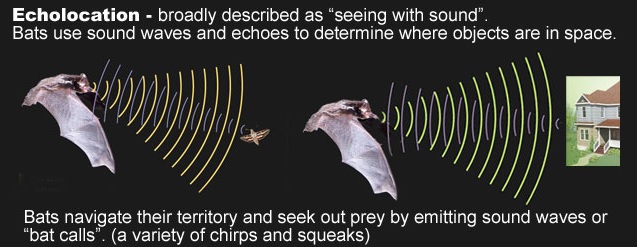
Bats use ultrasounds to navigate in the darkness. Bats use a variety of ultrasonic ranging techniques to detect their prey. They produce high pitched ultrasound squeaks. These high pitched squeaks are reflected by objects such as preys and returned to the bat’s ear. This allows bat to know the distance of his prey. They can detect frequencies beyond 100 KHz, possibly up to 200 kHz.

Ultrasound can also provide additional information such as the depth of flaws in a welded joint. Ultrasonic inspection has progressed from manual methods to computerized systems that automate much of the process. An ultrasonic test of a joint can identify the existence of flaws, measure their size, and identify their location.

Defects in metal blocks can be detected using ultrasound. Defects do not allow ultrasound to pass through them and they are reflected back as a result, it doesn’t get detected by the detector.

Diagnostic ultrasound is used externally in horses for evaluation of soft tissue and tendon injuries, and internally in particular for reproductive system.

Ultrasound is used to evaluate fat thickness, rib eye area, and intramuscular fat in living animals. It is also used to evaluate the health and characteristics of unborn calves

Ultrasonic cleaners frequency 20 to 40,000 Hz, are used to clean jewelry, lenses, optical instruments, watches and surgical instruments etc. An ultrasonic cleaner works mostly by energy released from the collapse of millions of microscopic cavities near the dirty surface. Objects to be cleaned are put in a cleaning solution and ultrasound waves are passed through that solution. The high frequency of these ultrasound waves detaches the dirt from the objects.

It is also used in killing bacteria in sewage. Ultrasonic cleaning is the rapid and complete removal of contaminants from objects by immersing them in a tank of liquid flooded with high frequency sounds waves. These non-audible sound waves create a scrubbing brush action within the fluid.

SONAR (Sound Navigation And Ranging) is an acoustic device used to measure the depth, direction and speed of under-water objects (submarines etc) with the help of Ultrasounds. It is used in measuring the depth of seas too. A beam produces by this device is passed through sea. This beams gets reflected and the echo is recorded by the detector, which converts it to electrical signals. This method is termed as ‘echo – ranging’.

The Product Life Cycle and The Law of Diminishing Returns: An Union of Marketing Management and Economics

By: Anamitra Roy

B.Com. Hons. (University of Calcutta, India), Certified Financial Accountant (CMC, India),DFA (CMC, India), PGDBF (HSIS India, India), Certified Business Case Analyst (TASMAC, India), Certified Financial Accountant (GLOBSYN Skills, India), GPBL (TASMAC & University of Wales, U.K.).

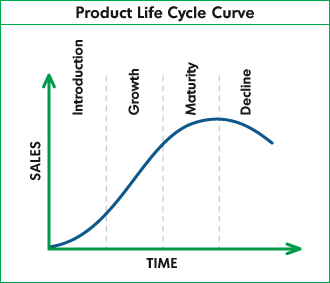
One of the most important concepts associated with modern day marketing management is that of the product life cycle. In this concept, the life span of a product is classified broadly into three classifications, which are as follows:

  1. The Phase of Introduction/ Development: This is the first phase of the product life cycle. In this stage the product gets developed. It gets introduced in the market. In this phase the entrepreneur has to work very hard to make the customers familiar with the product. Some marketing management scholars also prefer to call it the phase of formation.
  2. The Phase of Maturity: This is the second phase of the product life cycle. In this stage the product reaches a state of maturity and customers are very familiar with it. The product has the highest aggregate demand in the market at this stage. This is the stage when the entrepreneur earns the highest amount of profit and holds the lion’s share of the market sales.
  3. The Phase of Declining: The third and final phase of the product life cycle can be delayed but it cannot be eradicated.This is the third and final phase of the product life cycle. In this stage the demand for the product starts to come down in the market, thereby, bringing the profit margin also to an all time low. Another major characteristic feature of the declining phase from the point of view of human resource management is that motivation level of the employer and the employees also continue to go down.

Every product in the world has to undergo these three phases of the product life cycle irrespective of the nature and utility of it.

Quite similar to the product life cycle of marketing management there is a law in economics. This is called the “Law of Diminishing Returns.” This law deals with the diminishing returns/ utility value from the continuous use of a resource. For example, when a person is having a bottle of soft drinks say the utility derived out of that is “x”. Now on having the second bottle of soft drinks the utility value comes down to lesser than “x”. On having one more bottle of soft drink the utility value comes down further and it continues this way until at one point of time the utility value reaches the zero mark.

There are some points of similarity between the product life cycle of marketing management and the “Law of Diminishing Returns” of economics. A discussion on these is as follows:

  1. Based on the fundamental principle of diminishing marginal utility: In case of both the concept of product life cycle and the “Law of Diminishing Returns”, the marginal utility comes down due to factors like -Marginal utility is the utility of having an additional unit of the product. In the concept of product life cycle the demand for the product slowly and gradually comes down and then fades away. In the “Law of Diminishing Returns” also the same principle of diminishing marginal utility is used as a base.
  • Fatigue generated out of regular usage.
  • Monotony.
  • Changes in consumer behavior leading to alterations in tastes, preferences, buying and usage patterns of consumers.
  • Introduction of superior quality products in the market.
  • Improvement of competitors in terms of technology, management etc.
  • Rise in awareness leading to optimum usage of resources, thereby bringing the cost of substitute products down in the markets.

2. Applicable in case of individual and aggregate use: The concept of product life cycle and the “Law of Diminishing Returns” can be used in case of individual as well as aggregate usage of the market. The individual usage added together produces the aggregate usage.

3. Applicable in case of all types of products: In case of medicines and cancer drugs, the utility (satisfaction) value remains the same even after repeated usage. Hence, the demand for these commodities does not fall as per the “Theory of Marginal Utility.”

Giffen goods have been named after the famous Scottish economist Sir Robert Giffen. The world famous economist Alfred Marshall attributed this idea to Sir Robert Giffen in his book “Principles of Economics”. In economics and consumer theory, a Giffen good is a commodity whose demand does not fall with the rise in prices and vice versa. Examples of such goods are luxury goods like perfumes, art pieces, paintings etc.

Both the ideas in the discussion are applicable in case of all types of products. However there are some exceptions to it. Examples of these are medicines, cancer drugs, Giffen goods etc.

In spite of these similarities, there is a strong dissimilarity between the idea of product life cycle and the “Law of Diminishing Returns”. This difference is in the approach. The idea of product life cycle approaches to study the law of diminishing marginal utility from the stand point of a product. On the other hand, the “Law of Diminishing Returns” approaches to study marginal utility from the standpoint of utility or satisfaction.

In reality it is seen that the “Law of Diminishing Returns” is used to analyze the product life cycle. The stats of changing/ diminishing returns help us to understand in which phase of product life cycle the product is existing right now.

In this context, let me talk about one of my experiences.

In 2011 -12, I was working as the Centre Manager of the CMC Academy, Salt Lake City Branch which was situated in Salt Lake City, Kolkata, India. As the head of the organization I was very worried since September, 2011, as my business acquisition figures went drastically down and could not be pulled up despite measures taken by the marketing team. It was on January, 2012 we decided to interview the existing students of the institute on the basis of a questionnaire. This was being done with the objective of judging their satisfaction level. After the interview and in consultation of my bosses we realized that the academic courses being taught in the institute had reached a point of saturation. The stats revealed that following the “Law of Diminishing Returns”, the satisfaction generated from the academic courses taught in the institute were coming down like a house of cards, there by taking the whole institute towards the third and declining phase of the product life cycle.

We had limited time in our hands as we had to reach targets. We got tied up with the National Institute of Entrepreneurship and Small Business Development”. There was a flow of new products in the form of a new advance course on web designing. Our marketing team conducted two seminars at a nearby government college and we had 50 more students in just a month. By March, 2012 things were back in shape again. Organizational happiness and stability were restored.

In my professional career, this was a classical example of the “Law of Diminishing Returns” used to determine the phase of the product life cycle in which our products were placed. This is how, I realized about the union between marketing management and economics through the application of the concept of the product life cycle and the “Law of Diminishing Returns”.

How important is it for a marketing personnel to be happy?

By: Anamitra Roy

B.Com. Hons. (University of Calcutta, India), Certified Financial Accountant (CMC, India), DFA (CMC, India), PGDBF (HSIS India, India), Certified Financial Accountant (GLOBSYN Skills, India), GPBL (TASMAC, India & University of Wales, United Kingdom).

“Happiness is the secret to all beauty. There is no beauty without happiness.”

Christian Dior

 It was back in 2012 that I was reading an article on happiness. I still remember the writer raised a question in his writing. He asked the readers that how are it that some people are perennially happier and some are unhappy. The writer through his research reached the conclusion that happiness besides being dependent on social, political, technical, economical, geographical factors is also to a huge extent dependent on the genetic factors. I was very moved with this article although after so many years I do not remember the name of the writer or the article. I was very moved because right from my childhood I was very close to my Mom, who herself is a very happy person and has grown me to a happy person. So I could relate to the conclusion pointed out in that article that happiness is to a huge extent genetic. After that I went through a management program called “Global Program in Business Leadership (GPBL)” conducted by the TASMAC B – School and the University of Wales, United Kingdom. I had taken marketing management as my area of specialization in the yearlong GPBL program. After completion of this management program, I started to think about the importance of happiness in the marketing profession. I discussed about this with a lot of people. I closely observed the lives of many mid-level and top level marketing executives. I myself started to work as a marketing person. As a result of all these I reached a few conclusions in my mind which I am sharing with you all.

Let me clarify in the beginning that these conclusions are a result of observation and not research. So they can very easily be challenged. But still, I am sharing these conclusions with you all, because if you find it applicable in your life that would save time for the applicant. I have taken almost four years to reach to these conclusions. If, after reading this article, one can learn those in half an hour, then that would save time for that person and also for the entire human race as a whole. Thus, I will consider this as my share of contributions towards the growth and continuance of the human civilization.

On that note, my observations are as follows:

  1. Relating to the needs of the customer:I will give you a simple example. I was once having a chat with a renowned dermatologist. He was telling me about one of his experiences with a patient. This patient was a young man. He had developed a white patch in his arm. Within a span of almost ten years, it occupied a major portion of his arm. He never had any problem with this white patch because this skin disease was painless. But he started to have a problem with it the moment his marriage was fixed. He was embarrassed about the white portion of his arm. After all, all of us love to pose a perfect picture of ourselves in front of our newly married ones. That’s basic human psychology and I do not want to expand on that. The young man met the dermatologist in his chamber and requested him to remove the white patch in ten/ fifteen days. The dermatologist told him that a problem that was there for ten years cannot be eradicated in just a few days. But he promised to manage it to the highest extent possible within ten days. Trust me; this was one of the greatest stories of how someone could relate to the needs of another. Marketing is all about relating to the needs of the customers. For this you need to think. You can think well when you are happy. Thus you need to be happy in order to relate yourself to the needs of the customers. I was always and almost always told by my teachers that marketing is ultimately trying to relate you with the needs of the customers. You will have to fit in the shoes of your customers/ clients. Then only you will be able to relate to them.
  2. Endorsing the Brand: There are so many celebrities around the world who endorse brands. In India some of the most popular brand ambassadors are actors like Amitabh Bachchan, Shah Rukh Khan, Aishwarya Rai, sports personalities like Sachin Tendulkar, Mahendra Singh Dhoni, Sania Mirza etc. All these personalities while endorsing whichever brands they endorse do it with a happy face. A happy face is easily approachable than a gloomy face and so people are fond of happy faces. This is not only true in case of celebrities but also in case of marketing persons. When a marketing person approaches a client/ customer he is the sole representative of the organization. People do not care about who is the CEO of the organization. For them the marketing person that they meet in shops, malls, outlets and markets, represents the whole organization. That is why, it is extremely important for the marketing person to approach the customers/ clients with a happy face. This is because the happy face of the marketer says that the organization that he is representing is a happy one.
  3. Product Life Cycle: Let me for the time being, concentrate on the third and final phase i.e. the stage of declining. This is a stage that is unavoidable. It can be delayed but it cannot be avoided. Marketing scholars around the world are researching on how to delay the arrival of this declining phase. If I am asked personally, then I would say that this is the phase when happiness is most wanted to keep the work force motivated but at the same time this is also true that this is the phase when happiness is most difficult to achieve. This is because a declining graph indicates cash crunch, lack of confidence of the employees, internal feud within the organization and lack of interest in the job. There is only one solution to this. The answer is happiness. Happiness is the only way by which you can delay the arrival of the third and declining phase. A happy mind can take up more pressure and work load. To delay the arrival of the third and final phase you need to work more and achieve the targets. That’s possible only if you posses a happy mind. There are three phases of product life cycle. The first phase is the phase of introduction, the second phase is the phase of maturity and the third phase is the phase of declining.
  4. Absorption of Pressure: I remember as a growing kid I used to watch a lot of sports in the nineteen nineties. At that time, Ajay Jadeja was a very popular sporting star who represented India at the international level. He always had a smiling face. Even when he was playing and his team was losing he would smile. He was a happy person and he displayed his happiness … a great way to tackle pressure. In a lot of interviews, Jadeja spoke about this habit that he had developed since his childhood. He always believed that this was his way of tackling pressure. In the marketing profession, you will be under severe pressure. This pressure comes from your employer, your clients, your customers, your team members and also sometimes from yourself. You will have to absorb this pressure. There are ways of doing it. Absorption of pressure is a science. It is not an art. It is not dependent on individuals. You can absorb more pressure when you are happy. You can work more when you are happy. In all the leading organizations you will see the HR department working towards the happiness of employees. In fact, this is a new and very interesting vertical that has been added to the field of HRM. I remember when my Dad worked for Union Carbide; he was the member of the Volt ‘n Half Recreation Club. This was an in-house club for the working executives of that company who used to arrange periodical picnics, get together programs, musical performances by eminent musicians and other cultural activities. All these used to be done to keep the executives happy.
  5. Decision Making: Decision making is a principle of management that is common to whichever field of life you are. But it is particularly important in the field of marketing. In this field when you are taking decisions, your decisions will be influencing the fate of the organization. And, that’s true even if you are just a junior executive. You are taking decisions about the product, about how to pitch the product, about the approach to the customer/ client. Even if you are not the CEO, your decisions have the strength to influence the image and future of the organization. Now, how do you think every minute you are going to take decisions as crucial as these if you are not happy? Happiness is that important in the field of marketing. It will enable you to work freely and take decisions freely.

In conclusion, let me share with you all that there have been days in my career when I have received the most horrible of the thrashings from my boss. These had happened at times without any fault of mine. How do I recover in just one day? I had to go to the office the next day and face the same boss. Happiness is extremely important in whichever sphere of life you are but it is particularly important in the field of marketing. It will help you to go on and on despite the severe pressure. In this field of marketing on some days you would be required to travel more than 200 kilometers in a day, sometimes when the temperature is around 45 degrees Celsius. You know, I have personally experienced this that when you are in such a situation although marketing may be your passion, your life; still you may curse yourself for taking up this profession. The question is in such a phase of your life when you are cursing yourself for taking up this profession which is the best according to you, how do you inspire yourself? The answer is simple. “Happiness.” Be happy and you are done.

This write up that I have written is to a huge extent autobiographical. I have looked at life and learnt these lessons that I have shared with you in this writing. Please do feel free to share your opinions with me at my mail ID which is roy_2009@rediffmail.com

I would love to hear from all of you … my dear readers.

“Thousands of candles can be lighted from a single candle, and the life of the candle will not be shortened. Happiness never decreases by being shared.”

Buddha

Importance of Planning as a Management Function

By Prapanna Lahiri

Planning is the first managerial function. In exercising this function the manager will create a detailed action plan aimed at achieving some organisational goals. Planning is an ongoing function and can be highly specialised based on organisational goals, division goals, departmental goals, and team goals.

Definitions:

Based on the above statements Planning can be defined as a – systematic activity of thinking in advance to determine when, how and who is going to perform a specific job. Planning entails setting objectives and deciding in advance the appropriate course of action to achieve these objectives.  Accordingly, one can also define Planning as setting up of objectives and targets and backing it up with an action plan to achieve them. Simply put, Planning is a detailed programme regarding future courses of action.

Importance of Planning:

It is a systematic and specialised organisational activity in view of its following distinctive characteristics:

  1. Planning follows objectives: Planning begins with determination of objectives which provide the nucleus to the planning process. After the objectives are set, planning decides the methods, procedures and steps to be followed to achieve these objectives. Objectives should be practical, acceptable, workable and achievable.
  2. Planning is pervasive: Planning is not restricted to the top level of management only but is also done by managers at every level. Depending on goals set at every level – be it a department, a division or a team assigned a specific job, a planning blueprint has to be drawn up.
  3. Planning is futuristic/ forward looking: Since Planning is essentially looking ahead, it is a futuristic function. Planning cannot be done for the past. Based on past experiences managers attempt to make predictions and assumptions called ‘Planning Premises’ about the likely shape of events in future. Planning premises may be internal or external. Internal premises that may include capital investment policy, management labour relations, philosophy of management etc. are controllable whereas external premises that include socio- economic and political changes are non- controllable. The premises are established for determining where one tends to deviate from the actual plans and causes of such deviations.
  4. Planning is ongoing/ continuous: Planning is a never ending process. When forecasts are available and premises established, a number of alternative courses of action are taken for consideration. Alternatives are scientifically and objectively evaluated by employing quantitative techniques, weighing their pros and cons in the light of resources available and requirements of the organisation. The best alternative is chosen, basis its stability to attain the desired objective. There is scope for course correction midway depending on the prevailing environment.
  5. Planning is a mental exercise: Planning is an intellectual process requiring higher level of thinking and mental exercise. F.W. Taylor, the proponent of the theory of Scientific Management wrote about applying scientific (quantitative) techniques to planning. He separated planning from operational activities. In planning, assumptions and predictions regarding future are made by scanning the environment properly. Planning requires higher level of intelligence to select the most suitable alternative after evaluating various alternatives.
  6. Planning provides Direction: Planning being a predetermined course of action provides the directions to the efforts of employees. After the plans are formulated the subordinates who have to implement these plans are taken into confidence telling them in advance about the direction they have to tread. This ensures ‘Unity of Direction.’ Without planning, employees would be working in different directions making it impossible for the organisation to achieve its desired goals.
  7. Derivative/ secondary plans formulated: Secondary and Sub plans are derived from the basic plan detailing policies, procedures, rules, programmes, budgets, schedules, etc. for each department. All employees, supervisors and managers will integrate their activities based on these plans.
  8. Planning Reduces uncertainties: Planning premises being assumptions regarding future uncertainties based on past experiences uncertainties are sought to be minimised.
  9. Planning facilitates Management by Exception: Controlling means comparison between planned standards and actual output. Variances are calculated and analysed to their causes to find what went wrong and where.
The purpose of planning becomes meaningless unless its efficacy is evaluated. The appraisal of plans enables the planners to correct deviations or modify future plans to make them more realistic.

Reference:

http://www.ncert.nic.in/ncerts/l/lebs104.pdf

http://www.managementstudyguide.com/planning_function.ht

http://study.com/academy/lesson/frederick-taylor-theories-principles-contributions-to-management.html